10 Signs Your Business Doesn't Need a Full CRM Yet

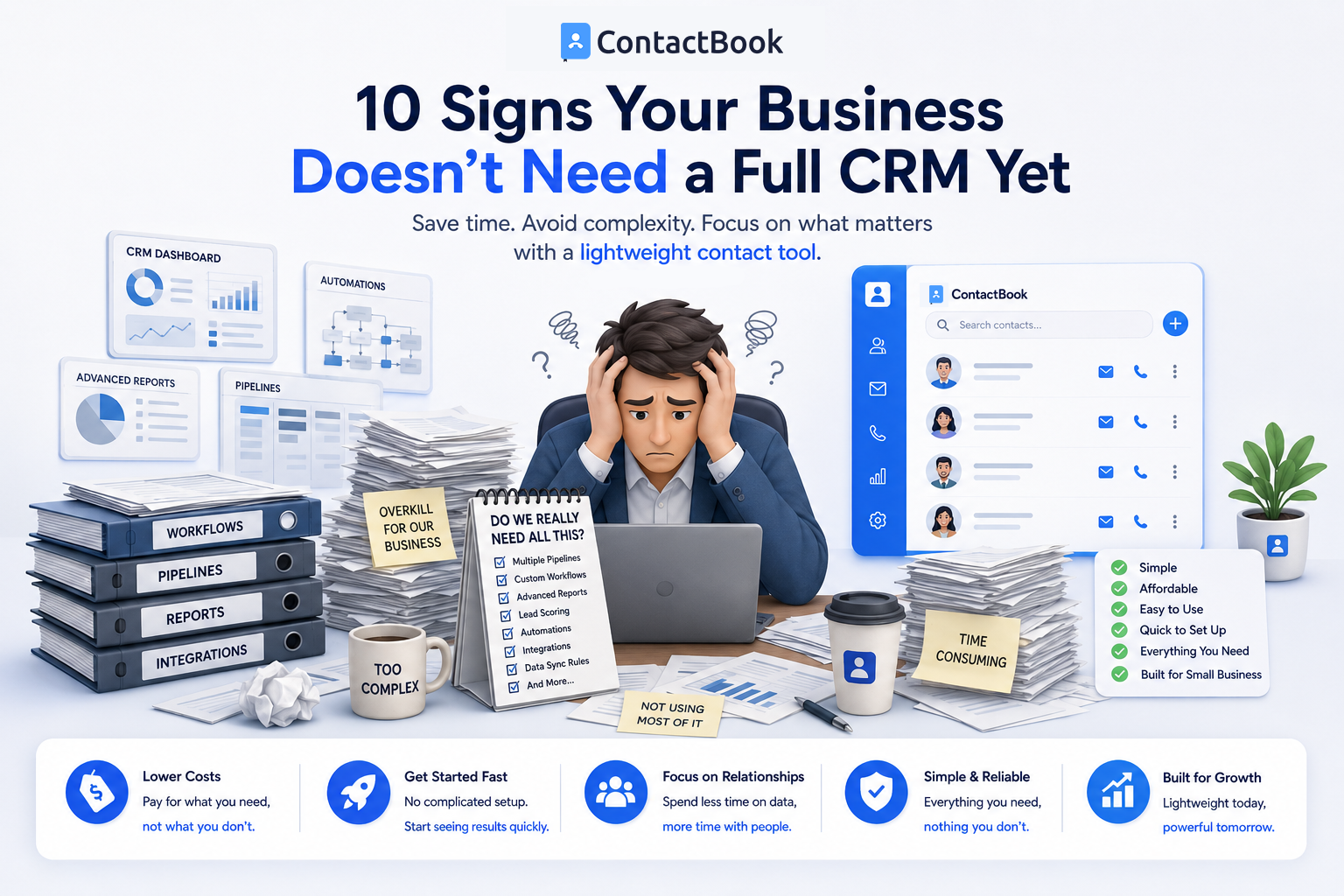
Customer Relationship Management (CRM) software is often seen as a must-have for growing businesses. While CRM platforms offer powerful features like sales pipeline management, marketing automation, forecasting, and customer analytics, they aren't the right fit for every company.
Many small businesses spend money on complex CRM systems only to use a small fraction of their capabilities. If your main goal is simply to organize contacts, improve team collaboration, and keep customer information accessible, a dedicated contact management tool may be all you need.
In this article, we'll look at 10 signs your business doesn't need a full CRM yet and explain why a lightweight contact management solution like ContactBook could be a better choice for your current stage of growth.
What Does a Full CRM Do?
A full CRM is designed to manage every stage of the customer lifecycle. It combines contact management with sales tracking, marketing campaigns, reporting, workflow automation, and customer service tools.
For businesses with large sales teams and complex processes, these features provide significant value. However, companies with simpler workflows may find that a full CRM introduces unnecessary complexity and higher costs.
When a CRM Makes Sense
Businesses that manage long sales cycles, multiple sales representatives, detailed opportunity tracking, and advanced customer reporting often benefit from a full CRM.
If those needs don't apply to your business today, there's a good chance a dedicated contact management tool will meet your requirements more effectively.
10 Signs You Don't Need a Full CRM Yet
Recognizing your current business needs can help you invest in software that delivers value without adding unnecessary complexity.
1. Your Main Priority Is Managing Contacts
If your daily work revolves around organizing customer, client, supplier, or partner information, you probably don't need advanced CRM features.
A contact management tool provides centralized access to contact details, notes, groups, and shared address books without requiring complex setup.
2. You Don't Have a Dedicated Sales Team
Many CRM platforms are built around sales pipelines and opportunity management.
If your business doesn't have multiple sales representatives actively tracking deals, much of a CRM's functionality may remain unused.
3. Your Sales Process Is Simple
Some businesses don't follow a structured multi-stage sales pipeline.
Service providers, consultants, agencies, healthcare practices, educational institutions, and nonprofits often build relationships through direct communication rather than detailed sales workflows.
4. You're Still Using Spreadsheets for Contacts
If spreadsheets currently meet most of your needs, your biggest challenge is probably organization rather than sales management.
Moving to a dedicated contact management platform is often the logical next step before investing in a full CRM.
5. Your Team Needs Shared Contacts More Than Sales Reports
Many growing businesses simply want employees to access the same customer information.
Shared contact lists, centralized contact storage, and team collaboration often deliver more immediate value than advanced reporting dashboards.
6. You Rarely Use CRM Automation Features
Many businesses purchase CRM software because of automation capabilities but rarely use them.
If marketing automation, lead scoring, and workflow automation aren't part of your daily operations, paying for those features may not make financial sense.
7. Training Employees Takes Too Long
Complex software often requires onboarding sessions, documentation, and ongoing support.
If employees struggle to learn the platform or avoid using it altogether, a simpler contact management solution may lead to better adoption across the organization.
8. Software Costs Are Increasing
Most CRM platforms charge per user, making costs rise as your team grows.
If you're paying for features your business doesn't need, switching to a lightweight contact management tool can reduce expenses while maintaining productivity.
9. Your Business Focuses on Relationships, Not Pipelines
Some businesses succeed by maintaining strong relationships rather than managing complex sales funnels.
In these cases, organized contact information and easy collaboration are often more valuable than detailed sales forecasting.
10. You Need Simplicity More Than Complexity
The best software is the one your team actually enjoys using.
If employees primarily need fast access to contact information and easy collaboration, choosing a dedicated contact management platform keeps workflows efficient without overwhelming users.
Why Contact Management Tools Are Often the Better Starting Point
Many businesses assume they need enterprise-level software as soon as they begin growing. In reality, starting with a dedicated contact management solution can be a smarter and more cost-effective decision.
Easier to Learn
Lightweight contact management platforms focus on essential features, allowing employees to become productive quickly.
Less training means faster adoption and fewer support requests.
Better Contact Organization
A dedicated contact management system keeps customer information centralized, searchable, and easy to maintain.
This improves collaboration while reducing duplicate records and outdated information.
Ready to Grow with Your Business
As your contact database grows, dedicated contact management software continues to provide efficient organization without unnecessary complexity.
If your business eventually requires advanced CRM capabilities, you'll already have a clean and organized contact database to build upon.
How ContactBook Supports Growing Businesses
ContactBook is built for businesses that need powerful contact organization without the complexity of a traditional CRM.
With centralized contact management, shared contact lists, custom groups, secure access controls, and an intuitive interface, ContactBook helps teams organize business relationships, collaborate more effectively, and access accurate contact information from anywhere.
For small businesses that want simplicity, affordability, and better organization, ContactBook provides the essential tools needed to manage contacts confidently while leaving room to grow.
Common Mistakes
One common mistake is choosing software based on future possibilities rather than current business needs. Buying an enterprise CRM too early often results in higher costs and lower employee adoption.
Another mistake is believing that more features automatically lead to better productivity. In many cases, simple software improves efficiency because employees can learn and use it more easily.
Businesses should also avoid delaying contact organization. Even if a full CRM isn't necessary today, maintaining clean, centralized contact information creates a strong foundation for future growth.
Frequently Asked Questions
Do all small businesses need a CRM?
No. Many small businesses only need a reliable way to organize and share contacts. If your workflows don't involve complex sales pipelines or advanced reporting, a dedicated contact management tool may be a better fit.
What is the difference between a CRM and a contact management tool?
A CRM includes features like sales pipeline management, forecasting, marketing automation, and reporting. A contact management tool focuses primarily on organizing, updating, and sharing business contacts efficiently.
When should a business upgrade to a full CRM?
A business should consider a full CRM when it manages multiple sales representatives, complex sales processes, advanced customer reporting, and extensive workflow automation that goes beyond basic contact management.
Final Thoughts
A full CRM can be an excellent investment for businesses with complex sales operations, but it isn't the right solution for everyone. Many small businesses achieve better results by focusing first on organizing contacts, improving collaboration, and keeping customer information accessible.
Recognizing the signs that your business doesn't need a full CRM yet can help you avoid unnecessary costs and choose software that aligns with your actual needs. Lightweight contact management tools offer the simplicity, flexibility, and efficiency many growing businesses are looking for.
If your priority is maintaining organized business contacts rather than managing advanced sales pipelines, ContactBook provides a practical and user-friendly solution. By centralizing contact information and making it easy for teams to collaborate, businesses can build stronger relationships today while remaining prepared for future growth.

.png)


.svg)


.svg)