AI Workflows Fail When Contact Data Is Messy: The Hidden Automation Problem Most Teams Ignore

Artificial Intelligence is transforming how businesses operate.
From automated email outreach and lead scoring to customer support, recruitment, sales forecasting, and workflow automation, AI promises faster decisions and greater efficiency. Organizations across industries are investing heavily in AI-powered tools to improve productivity and gain a competitive advantage.
Yet many teams encounter a frustrating reality.
They implement AI solutions, connect their data sources, launch automation workflows—and the results are disappointing.
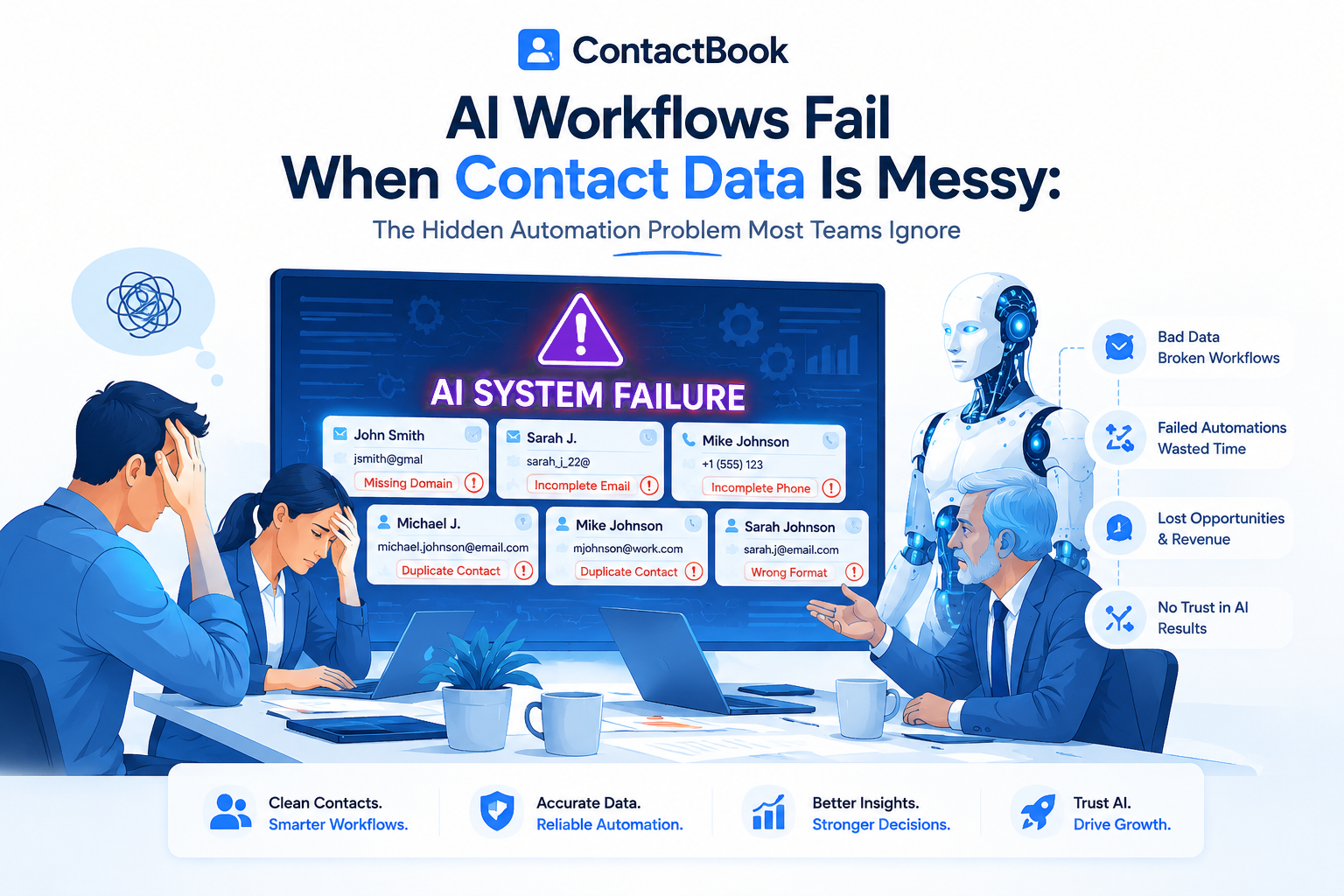
The AI produces inaccurate recommendations. Duplicate contacts appear. Outreach campaigns target the wrong people. Automation workflows break unexpectedly. Team members lose trust in the system.
The immediate reaction is often to blame the AI.
But in most cases, the real problem isn't the AI itself.
It's the data.
More specifically, it's messy contact data.
As organizations rush to adopt AI, many overlook a critical fact: AI workflows are only as effective as the quality of the information they can access. If your contact database is fragmented, outdated, duplicated, or incomplete, even the most advanced AI tools will struggle to deliver meaningful results.
This hidden challenge has become one of the biggest barriers to successful automation in modern businesses.
The Foundation of Every AI Workflow
Every AI workflow relies on data.
Whether you're using AI for sales automation, customer relationship management, recruiting, marketing campaigns, or internal operations, the system must access accurate information to make decisions.
Contact data often serves as the foundation for these workflows.
This includes:
- Customer contacts
- Leads and prospects
- Vendors and partners
- Investors
- Candidates and talent pools
- Clients
- Employees
- Stakeholders
AI tools continuously analyze this information to identify patterns, automate actions, and generate recommendations.
When contact data is accurate and organized, automation performs efficiently.
When contact data is messy, the entire workflow becomes unreliable.
What Is Messy Contact Data?
Messy contact data refers to contact information that is inaccurate, incomplete, outdated, duplicated, or scattered across multiple systems.
Many organizations don't realize how widespread this problem has become.
Common examples include:
Duplicate Contacts
The same person appears multiple times across different systems.
One record may contain an email address.
Another may contain a phone number.
A third may include recent communication history.
AI systems struggle to determine which record is correct.
Outdated Information
People change jobs, phone numbers, email addresses, and responsibilities.
If contact records aren't maintained regularly, automation workflows rely on inaccurate information.
Missing Context
Many databases contain basic contact information but lack important relationship details.
Without interaction history, notes, tags, and context, AI cannot fully understand the significance of a contact.
Data Silos
Contact information often lives across:
- CRM platforms
- Spreadsheets
- Email inboxes
- Project management tools
- Shared drives
- Individual employee records
When information remains fragmented, AI cannot access a complete picture of relationships.
Why AI Struggles with Poor Contact Data
Businesses often assume AI can compensate for bad data.
In reality, AI amplifies data quality issues.
The more automation you introduce, the more visible these problems become.
Inaccurate Recommendations
AI-powered systems rely on historical data to identify patterns and make suggestions.
If contact records are incomplete or duplicated, recommendations become unreliable.
A sales team may receive poor lead prioritization.
A recruiter may overlook qualified candidates.
A customer success team may miss critical opportunities for engagement.
Broken Automation Workflows
Automation depends on triggers and conditions.
If contact information is inconsistent, workflows may fail entirely.
For example:
- Follow-up emails may never send.
- Tasks may be assigned incorrectly.
- Contacts may enter the wrong workflow.
- Teams may receive inaccurate alerts.
Duplicate Outreach
One of the most common automation failures occurs when duplicate contact records exist.
The same individual may receive multiple emails from different workflows.
This creates confusion, damages trust, and negatively impacts brand reputation.
Reduced Team Confidence
When employees repeatedly encounter inaccurate AI-generated outputs, confidence in automation decreases.
Eventually, team members stop relying on the system altogether.
The result is lower adoption and wasted technology investments.
The Growing Cost of Bad Contact Data
Messy contact data doesn't just affect technology.
It affects business performance.
Organizations often underestimate the cost associated with poor data management.
Some of the most common consequences include:
Lost Productivity
Teams spend hours manually cleaning records, searching for information, and correcting errors.
Poor Customer Experiences
Customers receive irrelevant communications or repetitive outreach.
Missed Revenue Opportunities
Sales teams fail to identify important relationships or high-value prospects.
Inefficient Recruiting
Recruiters repeatedly source candidates they already know because historical contact data is difficult to access.
Reduced ROI on AI Investments
Companies invest thousands of dollars in AI tools but fail to achieve expected results because foundational data issues remain unresolved.
Why Contact Management Matters More Than Ever
As AI adoption accelerates, contact management is becoming a strategic business function rather than an administrative task.
Organizations that maintain organized contact data gain several advantages.
Better Automation Accuracy
Clean data enables AI systems to generate more reliable recommendations and decisions.
Improved Relationship Intelligence
Teams gain greater visibility into customers, prospects, partners, and stakeholders.
Faster Decision-Making
Employees spend less time searching for information and more time acting on insights.
Stronger Collaboration
A centralized contact database ensures teams work from the same information.
Future-Proof Operations
Companies with organized contact data are better positioned to adopt new AI technologies as they emerge.
Signs Your Contact Data Is Hurting Your AI Workflows
Many organizations don't realize they have a contact data problem until automation begins to fail.
Common warning signs include:
- Duplicate records across systems
- Difficulty finding the right contact
- Inconsistent customer information
- Multiple versions of the same spreadsheet
- Repeated outreach to the same people
- Poor CRM adoption
- Missing interaction history
- AI recommendations that seem inaccurate
- Manual data corrections becoming routine
If these issues sound familiar, your organization may have a contact management problem disguised as an AI problem.
Building an AI-Ready Contact Database
The solution isn't necessarily more AI.
It's better data management.
Organizations looking to maximize automation performance should focus on creating a reliable contact foundation.
Key practices include:
Centralize Contact Information
Store contacts in a shared system accessible across teams.
Eliminate Duplicates
Maintain a single source of truth for every contact.
Standardize Data Entry
Ensure information is captured consistently.
Maintain Relationship Context
Track interactions, notes, tags, and communication history.
Improve Accessibility
Make it easy for teams to search, update, and manage records.
Regularly Audit Data Quality
Review and update contact records to maintain accuracy over time.
These practices significantly improve the effectiveness of both automation and AI initiatives.
The Future of AI Depends on Better Contact Management
The conversation around AI often focuses on algorithms, automation platforms, and emerging technologies.
But the organizations achieving the best results understand something important:
AI success starts long before the algorithm.
It starts with data quality.
As AI becomes embedded into daily business operations, companies with organized, accessible, and accurate contact data will outperform those relying on fragmented systems and outdated spreadsheets.
The future belongs to organizations that treat contact management as a strategic asset rather than an operational afterthought.
How ContactBook Helps Teams Build AI-Ready Contact Data
At ContactBook, we believe successful automation begins with organized relationships.
Many businesses struggle because contact information is scattered across spreadsheets, inboxes, CRMs, and disconnected tools. This fragmentation makes collaboration difficult and limits the effectiveness of AI-powered workflows.
ContactBook helps teams create a centralized, searchable, and structured contact database that serves as a reliable source of truth for the entire organization.
With ContactBook, businesses can:
- Centralize contact information
- Reduce duplicate records
- Improve team collaboration
- Organize relationship data
- Maintain contact history and context
- Create cleaner data for AI and automation workflows
As organizations continue investing in artificial intelligence, the quality of their contact data will increasingly determine the success of those initiatives.
The smartest companies are realizing that AI isn't just about automation.
It's about creating the right foundation for automation to succeed.
And that foundation starts with better contact management.
Final Thoughts
When AI workflows fail, technology isn't always the problem.
In many cases, messy contact data is the hidden obstacle preventing automation from delivering its full potential.
Before investing in more tools, businesses should ask a simple question:
"Can our AI trust the data we're giving it?"
Organizations that prioritize contact management, data quality, and relationship visibility will unlock better automation outcomes, stronger collaboration, and greater long-term value from their AI investments.
Because in the age of AI, clean contact data isn't just an operational advantage.
It's a competitive advantage.

.png)

.svg)


.svg)