Best Contact Management Software for Small Businesses in 2026

Running a small business means wearing multiple hats. One day you're following up with customers, the next you're talking to suppliers, onboarding employees, or networking with new partners. As your business grows, keeping track of all these relationships becomes increasingly difficult without the right tools.
Many small businesses begin with spreadsheets, phone contacts, or email address books because they're easy to use and inexpensive. While these methods work for a small number of contacts, they quickly become difficult to manage as your customer base expands and more team members need access to the same information.
That's where contact management software comes in. Instead of storing contacts in multiple places, these tools help businesses organize, share, and maintain contact information from one centralized platform.
In this guide, we'll explore the best contact management software for small businesses in 2026, what features to look for, and how to choose the right solution for your team.
Why Small Businesses Need Contact Management Software
As a business grows, so does the number of people you interact with. Customers, vendors, contractors, employees, partners, and prospects all become part of your daily operations.
Without a structured system, finding accurate contact information becomes time-consuming and increases the risk of missed opportunities.
Better Organization
A dedicated contact management system keeps all business contacts in one place.
Instead of searching through spreadsheets, email threads, or personal phones, employees can quickly locate the information they need.
Easier Team Collaboration
When multiple employees work with the same customers, everyone needs access to consistent and up-to-date information.
Shared contact management reduces duplicate records and helps teams communicate more effectively.
Improved Business Continuity
If important contacts exist only on one employee's device, the business may lose access to valuable relationships when that employee changes roles or leaves.
Centralized contact management helps protect those business connections.
What to Look for in Contact Management Software
Not every business has the same requirements. Choosing the right software depends on how your team works and what challenges you're trying to solve.
Shared Contact Lists
The ability to create shared contact lists is essential for businesses where multiple employees communicate with the same customers or vendors.
This ensures everyone works from the same information.
Contact Organization
Look for software that supports groups, categories, tags, and custom fields.
These features make it easier to organize and search large contact databases.
User Permissions
Growing businesses often need to control who can view or edit certain contacts.
Permission settings help protect sensitive business information while allowing employees to access what they need.
Mobile Access
Business doesn't always happen at a desk.
Choose software that allows employees to access important contact information while working remotely or visiting customers.
Best Contact Management Software for Small Businesses
Here are some of the top contact management solutions to consider in 2026.
1. ContactBook
ContactBook is designed specifically for businesses that need to organize and share contacts across teams without the complexity of a traditional CRM.
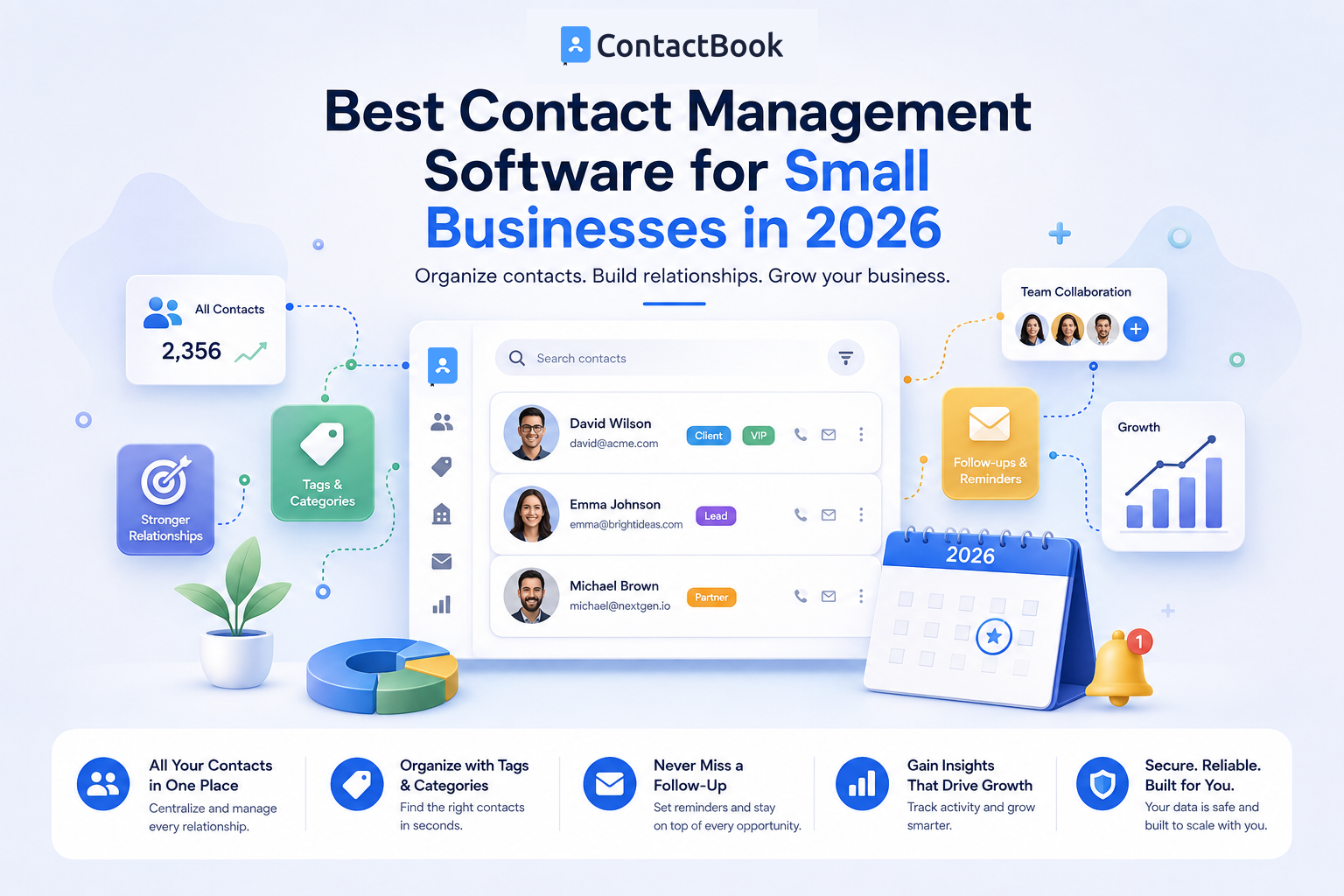
It offers centralized contact management, shared contact lists, custom groups, tags, permission controls, and an easy-to-use interface. Businesses can organize customers, vendors, partners, employees, and suppliers in one secure location while ensuring authorized team members always have access to accurate information.
Best for: Small businesses that want dedicated shared contact management without paying for unnecessary CRM features.
2. HubSpot CRM
HubSpot CRM combines contact management with sales, marketing, customer service, and reporting tools.
It is a strong option for businesses planning to manage their entire customer lifecycle from one platform, although smaller teams may find it offers more features than they currently need.
Best for: Businesses looking for a full CRM platform.
3. Zoho CRM
Zoho CRM includes contact management, workflow automation, sales tracking, and analytics.
Its flexible feature set supports growing businesses but may require additional setup compared to simpler contact management platforms.
Best for: Businesses expecting rapid growth and advanced CRM requirements.
4. Capsule CRM
Capsule CRM provides lightweight customer relationship management with an emphasis on contact organization and ease of use.
Its clean interface makes it attractive for startups and smaller teams.
Best for: Businesses wanting basic CRM capabilities alongside contact management.
5. Microsoft Outlook Contacts
Businesses using Microsoft 365 can manage contacts within Outlook and integrate them with other Microsoft applications.
While convenient for organizations already using Microsoft's ecosystem, it offers fewer collaboration features than dedicated contact management software.
Best for: Microsoft-based businesses with simple contact management needs.
Contact Management Software vs. CRM
Many small businesses assume they need a CRM when they actually need better contact organization.
A contact management system focuses on storing, organizing, searching, and sharing contact information. A CRM includes contact management but also adds features such as lead tracking, sales pipelines, forecasting, customer support, marketing automation, and reporting.
If your primary challenge is keeping business contacts organized and accessible, dedicated contact management software is often simpler, more affordable, and easier to adopt.
Why ContactBook Is a Great Choice for Small Businesses
Small businesses often need a solution that is powerful enough to support growth but simple enough for every employee to use.
ContactBook focuses on helping teams centralize business contacts, create shared contact lists, organize contacts with groups and tags, and improve collaboration across departments. Instead of paying for features you may never use, you get a platform built specifically for organizing business relationships.
Whether you're managing customer directories, vendor lists, employee contacts, or partner information, ContactBook helps your business stay organized while supporting future growth.
Common Mistakes
One common mistake is waiting until contact information becomes scattered across spreadsheets and personal devices before implementing a contact management system.
Another mistake is purchasing a complex CRM when your team mainly needs shared contact organization. Extra features often increase costs and training requirements without solving the core problem.
Businesses should also avoid choosing software without considering future growth. Selecting a scalable platform helps avoid unnecessary migrations later.
Frequently Asked Questions
What is the best contact management software for small businesses?
The best solution depends on your needs. Businesses focused on shared contact organizations often prefer ContactBook, while those requiring sales pipelines and marketing automation may consider CRM platforms such as HubSpot or Zoho.
Do small businesses need a CRM?
Not always. If your main goal is organizing and sharing business contacts, dedicated contact management software is often a better fit than a full CRM.
Can contact management software replace spreadsheets?
Yes. Contact management software provides centralized storage, shared contact lists, better organization, and easier collaboration than traditional spreadsheets, making it a more efficient long-term solution.
Final Thoughts
Managing business relationships becomes more challenging as your company grows. Relying on spreadsheets, personal address books, or scattered contact lists can slow your team down and increase the risk of outdated information.
The right contact management software helps small businesses stay organized, collaborate more effectively, and maintain stronger customer relationships without unnecessary complexity.
If you're looking for a solution designed specifically for organizing and sharing business contacts, ContactBook offers a simple yet powerful platform that supports growing teams. By centralizing contact information and making it accessible to authorized employees, ContactBook helps small businesses work smarter, improve communication, and build lasting business relationships in 2026 and beyond.

.png)


.svg)


.svg)