How AI Is Changing the Way Teams Manage Business Contacts in 2026

Every business runs on relationships. Whether you're closing deals, recruiting candidates, managing clients, or building partnerships, your contacts are among your most valuable assets.
Yet many teams still manage contacts using disconnected tools such as spreadsheets, personal phonebooks, email contact lists, and scattered CRM exports. The result is often duplicate records, outdated information, lost opportunities, and poor collaboration.
As businesses become more distributed and customer interactions increase, traditional contact management methods are struggling to keep up.
This is where Artificial Intelligence (AI) is making a significant impact.
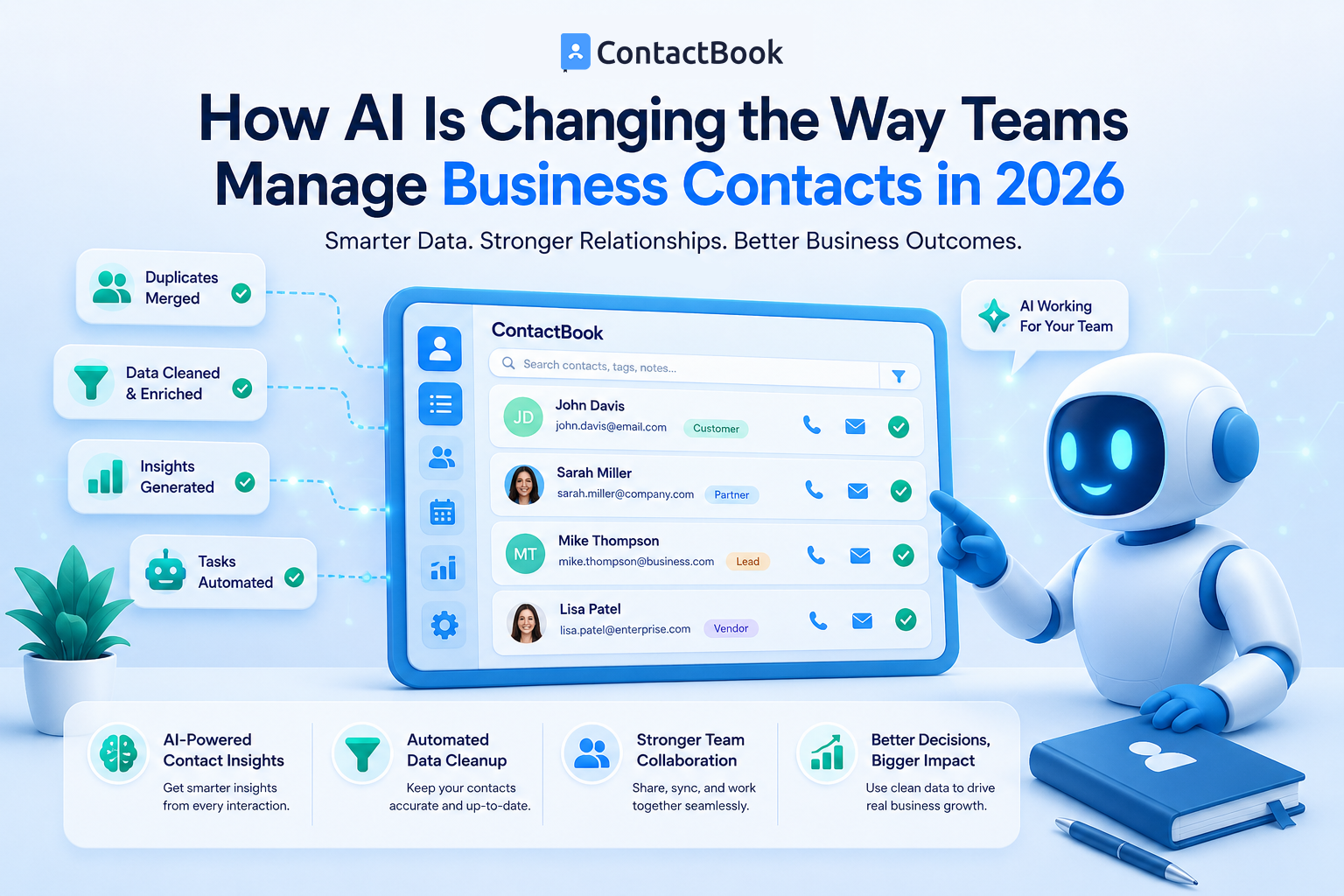
In 2026, AI is no longer limited to chatbots and content generation. It is actively helping teams organize, enrich, categorize, and manage business contacts more efficiently than ever before. Instead of spending hours maintaining databases manually, teams can now rely on AI to automate many of the repetitive tasks involved in contact management.
Let's explore how AI is transforming the way organizations manage business contacts and why more teams are adopting AI-powered contact management solutions.
The Growing Challenge of Contact Management
Modern businesses collect contacts from countless sources.
A sales representative might add a lead from LinkedIn. A recruiter may receive candidate information through email. Marketing teams collect contacts through forms and events. Customer success teams maintain client records across various tools.
Over time, contact information becomes fragmented.
Common problems include:
- Duplicate contact entries
- Missing phone numbers or email addresses
- Outdated information
- Contacts stored in personal devices
- No visibility across teams
- Time-consuming manual updates
These issues become even more challenging in remote and hybrid work environments where teams collaborate across multiple locations and devices.
Without a centralized and intelligent system, valuable business relationships often become difficult to manage.
What AI Brings to Contact Management
Traditional contact management systems act primarily as storage repositories.
AI-powered systems go much further.
Instead of simply storing information, AI can analyze contact data, identify patterns, automate updates, and provide recommendations that help teams work more efficiently.
The shift is moving contact management from a passive database into an active relationship management system.
This means businesses can spend less time maintaining records and more time building meaningful relationships.
1. Automatic Contact Enrichment
One of the most valuable applications of AI is contact enrichment.
Traditionally, employees needed to manually enter information such as company names, job titles, locations, and notes. This process is slow and often incomplete.
AI can automatically enrich contact records by analyzing available information and organizing it into structured profiles.
Benefits include:
- More complete contact records
- Reduced manual data entry
- Improved accuracy
- Better team visibility
When contacts contain richer information, teams can make better decisions and personalize interactions more effectively.
2. Smart Duplicate Detection
Duplicate contacts are one of the most common problems businesses face.
A single contact may exist multiple times across Gmail, spreadsheets, CRM systems, and employee devices.
These duplicates create confusion and reduce productivity.
AI-powered duplicate detection can identify similar records, compare information across sources, and recommend merging contacts into a single profile.
Advantages include:
- Cleaner contact databases
- Improved search results
- Better reporting accuracy
- Reduced confusion among team members
Instead of spending hours manually cleaning databases, teams can rely on AI to identify potential duplicates automatically.
3. Intelligent Contact Categorization
As contact databases grow, organization becomes increasingly important.
AI can automatically categorize contacts based on available information and interaction history.
For example, AI may identify whether a contact is:
- A client
- A prospect
- A vendor
- A partner
- A candidate
- An investor
This automated categorization helps teams quickly locate the right contacts without manually assigning every record.
The result is faster searching, improved segmentation, and more efficient workflows.
4. AI-Powered Contact Capture
Many valuable contacts are still collected through business cards, emails, networking events, and social platforms.
Unfortunately, manually entering this information remains one of the most time-consuming tasks for professionals.
AI simplifies this process through intelligent contact capture.
Modern AI systems can:
- Scan business cards
- Extract information from email signatures
- Capture contact details from social profiles
- Convert unstructured information into organized records
Instead of spending minutes entering contact information, users can create accurate records within seconds.
This allows teams to focus on relationship building rather than data entry.
5. Predictive Relationship Management
Perhaps the most exciting development in AI-powered contact management is predictive relationship intelligence.
AI can analyze engagement patterns and identify opportunities that may otherwise go unnoticed.
For example, AI can help teams identify:
- Contacts that haven't been engaged recently
- Important follow-up opportunities
- High-value relationships
- Inactive clients requiring attention
- Networking opportunities
These insights help professionals maintain stronger relationships without relying entirely on memory or manual tracking.
In many cases, timely follow-ups can be the difference between winning and losing business opportunities.
Why AI Matters More for Teams
The benefits of AI become even greater when contact management is shared across an organization.
Many businesses still rely on individual employees to maintain important contacts.
This creates risk.
When an employee leaves, valuable business relationships often leave with them.
AI-powered team contact management platforms help solve this problem by creating a centralized and collaborative environment where contact information remains accessible to authorized team members.
Key benefits include:
- Shared visibility
- Centralized contact ownership
- Real-time updates
- Reduced information silos
- Better collaboration
For growing businesses, this creates a significant competitive advantage.
Industries Benefiting Most from AI Contact Management
While nearly every organization can benefit from AI-powered contact management, several industries are seeing particularly strong results by transforming raw data into actionable relationships.
Real Estate
Agents can seamlessly organize high volumes of inbound leads, track changing prospect preferences, and manage sprawling client networks.
By automating follow-ups and interaction history, AI ensures agents never miss a critical touchpoint in a fast-moving market.
Recruitment
Recruiters can effortlessly maintain massive candidate databases and nurture long-term relationships with passive talent pools.
AI-driven insights help match candidates to open roles faster, keeping high-potential professionals engaged until the perfect opportunity arises.
Financial Services
Advisors can hyper-personalize client relationships while ensuring strict record-keeping is organized, compliant, and easily accessible.
The technology automates data entry and flags life milestones, allowing advisors to proactively offer timely wealth management advice.
Healthcare
Organizations can efficiently manage complex provider networks, external specialists, and essential professional relationships.
By streamlining communication channels and credential tracking, AI helps reduce administrative friction so teams can focus on operational efficiency.
Digital Agencies
Agencies can consolidate and manage a diverse ecosystem of clients, media partners, vendors, and prospects from a single, centralized database.
This unified view fosters smoother collaboration, optimizes pitch pipelines, and prevents communication silos across cross-functional teams.
Will AI Replace CRM Systems?
The short answer is no.
CRM platforms and AI-powered contact management systems serve different purposes.
CRMs focus on sales pipelines, opportunities, and deal management.
Contact management platforms focus on organizing, maintaining, and sharing relationship data.
For many businesses, both systems can work together.
However, companies that primarily need better contact organization and team collaboration may find that an advanced contact management platform delivers most of the value they need without the complexity of a traditional CRM.
The Future of Contact Management
The future of contact management will be increasingly intelligent.
Over the next few years, we can expect to see:
- More accurate contact enrichment
- Voice-assisted contact updates
- Automated follow-up recommendations
- Deeper relationship insights
- Smarter collaboration features
As AI continues to evolve, businesses will gain greater visibility into their networks and stronger control over their most important relationships.
Conclusion
Businesses don't struggle because they lack contacts.
They struggle because their contacts are scattered, outdated, duplicated, and difficult to manage.
AI is changing this reality.
By automating organization, enrichment, categorization, and relationship insights, AI helps teams spend less time managing data and more time building meaningful connections.
For organizations that depend on relationships to grow, AI-powered contact management is quickly becoming a necessity rather than a luxury.
Platforms like ContactBook are helping businesses centralize contacts, collaborate more effectively, and build stronger relationships through smarter contact management.

.png)


.svg)


.svg)