How Digital Agencies Can Stop Losing Client Contacts When Employees Leave

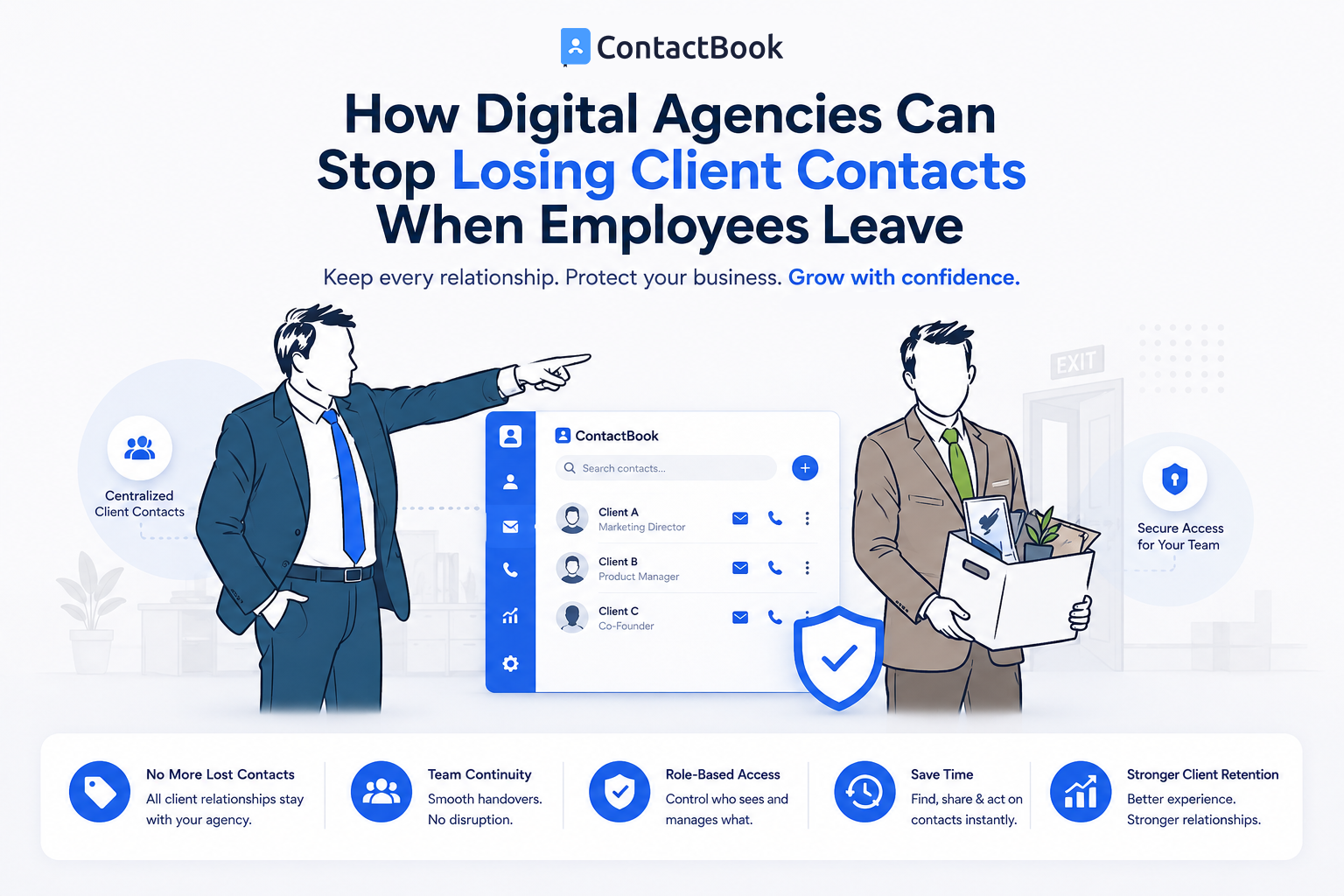
For digital agencies, client relationships are one of the most valuable business assets. Account managers, sales executives, project managers, and support teams communicate with clients every day through phone calls, emails, meetings, and messaging apps. Over time, these employees build extensive contact lists that keep projects moving and clients satisfied.
The problem arises when those contacts live only on an employee's phone, inbox, or personal address book. If an employee resigns or changes roles, important client information can disappear with them. This creates communication gaps, delays projects, and can even put long-term client relationships at risk.
The good news is that this problem is preventable. By using a centralized contact management system, digital agencies can ensure that client contacts remain with the business—not with individual employees.
In this article, we'll explain why agencies lose client contacts, the business impact of poor contact management, and how solutions like ContactBook help agencies protect valuable client relationships.
Why Agencies Lose Client Contacts
Client contact loss usually isn't caused by one major mistake. Instead, it happens because contact information is stored in multiple disconnected places without a clear ownership strategy.
As agencies grow, this issue becomes more difficult to manage.
Contacts Are Stored on Personal Devices
Many employees save client phone numbers and email addresses directly on their personal or company smartphones.
While this may be convenient, it means the agency does not have a centralized record of important business relationships. If the employee leaves, finding those contacts can become difficult.
Contact Information Is Scattered Across Multiple Tools
Agencies often communicate through email, messaging apps, spreadsheets, calendars, and project management platforms.
Without a dedicated contact management system, client information becomes fragmented, forcing employees to search through multiple tools whenever they need to reach someone.
No Shared Ownership of Client Relationships
When only one employee has access to key client contacts, the agency becomes overly dependent on that individual.
Unexpected absences, role changes, or resignations can disrupt communication and delay ongoing work.
The Business Impact of Losing Client Contacts
Poor contact management affects much more than daily communication. It can have a direct impact on client satisfaction and long-term business growth.
Delayed Client Communication
When employees cannot quickly find the correct contact details, responding to client requests takes longer.
Delays create frustration and can reduce confidence in the agency's ability to deliver reliable service.
Disrupted Project Handoffs
Employee turnover is a normal part of business.
However, if replacement team members cannot immediately access client contacts, project transitions become slower and less organized.
Lost Business Opportunities
Former clients often return with new projects, referrals, or partnership opportunities.
If important contact information has been lost, the agency may miss opportunities to reconnect and generate additional revenue.
How Centralized Contact Management Solves the Problem
A centralized contact management platform gives agencies one trusted location for storing and managing business contacts.
This ensures important client relationships remain with the organization instead of individual employees.
Create a Shared Client Directory
Instead of maintaining separate contact lists, agencies can store all client information in one centralized directory.
Authorized team members always have access to the latest contact details, making collaboration much easier.
Keep Contact Information Updated
Business contacts change over time. Clients switch roles, update phone numbers, or change email addresses.
With centralized contact management, updates are made once and become immediately available to everyone who has access.
Improve Team Collaboration
Account managers, project managers, designers, developers, and leadership teams often need access to the same client contacts.
Shared contact management ensures everyone works with consistent information, reducing duplicate records and unnecessary communication delays.
Why Spreadsheets and Personal Address Books Are Not Enough
Many agencies rely on spreadsheets because they are familiar and inexpensive. Unfortunately, they become increasingly difficult to manage as the client base grows.
Version Control Problems
Multiple spreadsheet copies often exist across different departments.
Employees may unknowingly use outdated versions, resulting in inconsistent client information.
Limited Security
Sharing spreadsheets through email or cloud storage provides limited control over who can view or edit sensitive business contacts.
Dedicated contact management software offers better permission controls and centralized administration.
Difficult Search and Organization
As contact lists become larger, spreadsheets become harder to navigate.
Dedicated platforms allow agencies to organize contacts using groups, tags, custom fields, and filters, making information easier to find.
How ContactBook Helps Digital Agencies Protect Client Relationships
ContactBook gives digital agencies a centralized platform for managing business contacts across teams. Agencies can create shared contact lists, organize clients by department, project, or account manager, and ensure authorized employees always have access to accurate contact information.
By keeping business contacts separate from personal devices, ContactBook helps agencies reduce dependency on individual employees while improving collaboration, project continuity, and client communication. Whether employees work from the office, remotely, or in hybrid environments, the agency retains ownership of its most valuable business relationships.
Common Mistakes
One common mistake is allowing employees to manage important client contacts only through personal phones or individual email accounts. This makes it difficult for the organization to maintain continuity when team members leave.
Another mistake is assuming spreadsheets are enough for growing client databases. While spreadsheets may work initially, they often lead to duplicate records, outdated information, and inconsistent collaboration.
Agencies should also establish clear processes for updating contact information regularly. A centralized contact management platform is most effective when teams treat it as the single source of truth for business contacts.
Frequently Asked Questions
Why do agencies lose client contacts when employees leave?
Client contacts are often stored on personal devices, individual email accounts, or disconnected spreadsheets. Without a centralized contact management system, valuable business relationships may become difficult to access after an employee leaves.
How can agencies prevent losing client information?
Agencies can centralize business contacts in a shared contact management platform where authorized team members can securely access and update client information.
Is a contact management tool better than spreadsheets for agencies?
Yes. Dedicated contact management software offers centralized access, real-time updates, better organization, permission controls, and easier collaboration than manually maintained spreadsheets.
Final Thoughts
Client relationships should belong to the agency, not to individual employees. When business contacts are scattered across personal devices and disconnected tools, employee turnover can disrupt communication and create unnecessary risks.
A centralized contact management system helps agencies maintain continuity by keeping client information organized, secure, and accessible to the right team members. It improves collaboration, supports smoother project handoffs, and protects valuable business relationships over the long term.
For digital agencies looking to strengthen client communication and reduce dependency on individual employees, ContactBook provides an easy-to-use solution for organizing and sharing business contacts. By centralizing client information, agencies can ensure that every relationship remains an asset of the business—regardless of team changes.

.png)


.svg)


.svg)