How to Turn Contacts Into Clients: 7 Proven Strategies That Work

Every business has contacts. Some are saved in phones, some are buried in email inboxes, some are stored in spreadsheets, and many are scattered across social media platforms. But having contacts is not the same as having clients.
A contact becomes a client only when there is trust, timing, relevance, and consistent follow-up. Many businesses lose opportunities not because they lack leads, but because they do not manage relationships properly after the first conversation.
The good news is that you do not need aggressive selling to turn contacts into clients. You need a clear process. When you understand your contacts, communicate with them personally, and follow up at the right time, you can convert more relationships into real business opportunities.
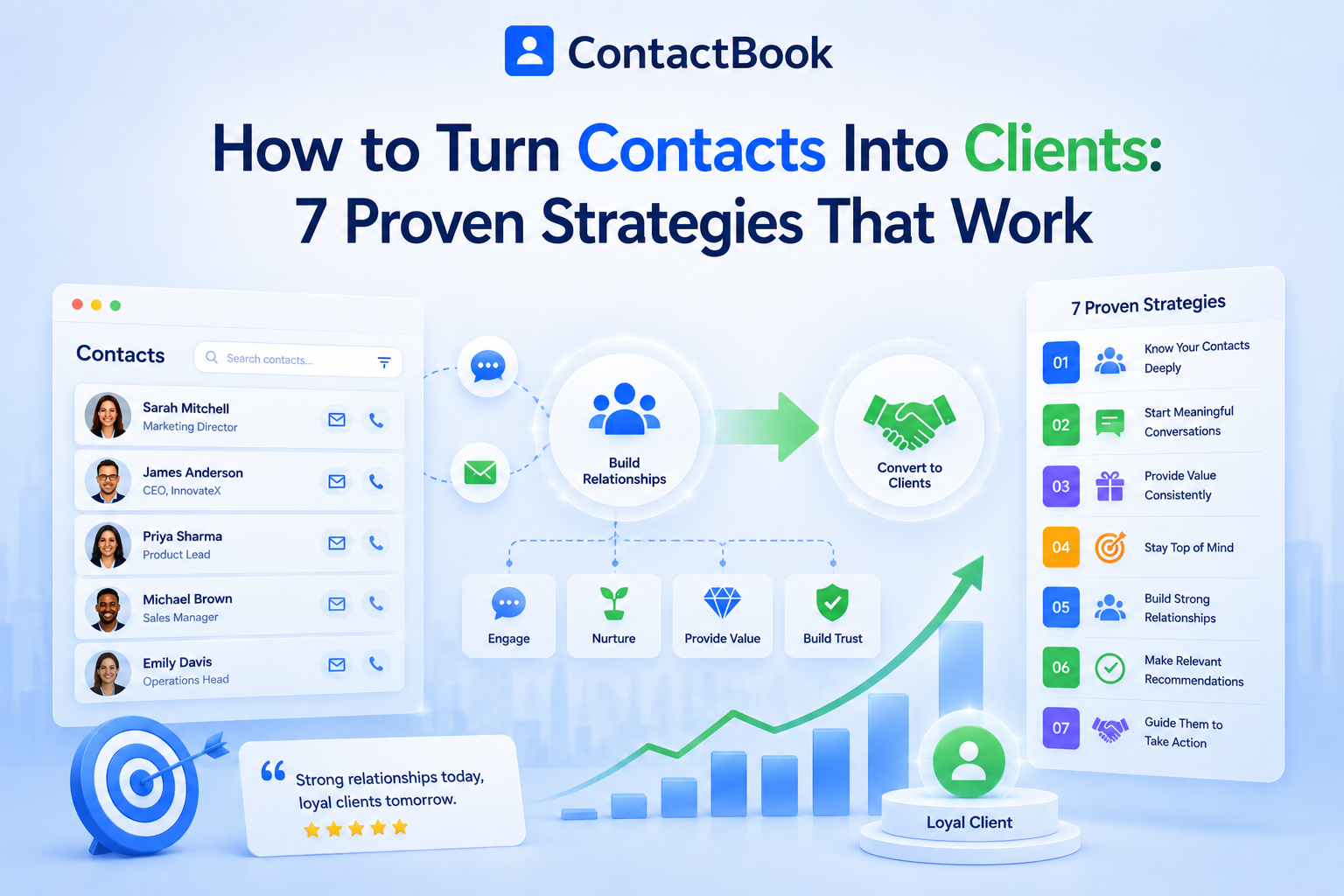
In this blog, we will explore seven proven strategies to help you turn contacts into clients and build stronger business relationships.
Strategy 1: Organize Your Contacts Before You Sell
Before you try to convert contacts into clients, you need to know who they are, where they came from, and what they need. A messy contact list makes follow-up difficult and causes good opportunities to slip away.
- Bring all contacts into one place
Your contacts may be spread across your phone, email, LinkedIn, business cards, spreadsheets, and website forms. Start by collecting them in one central contact management system so you can access everything easily.
- Separate personal and business contacts
Not every contact is a potential client. Some may be friends, vendors, partners, employees, or industry peers. Separating business prospects from general contacts helps you focus your efforts.
- Add useful context
Save details such as where you met the person, what they were interested in, their company, role, location, and any previous conversations. This context helps you personalize future communication.
- Remove duplicate and outdated entries
Duplicate contacts and old information create confusion. A clean contact list makes your sales process faster, more accurate, and more professional.
When your contacts are properly organized, you stop guessing and start building relationships with purpose.
Strategy 2: Segment Contacts Based on Their Needs
Not every contact is ready to become a client immediately. Some may be interested now, some may need time, and others may only be useful as referral partners. Segmentation helps you communicate with each person in the right way.
- Group contacts by interest
Organize contacts based on what they care about. For example, a real estate agent may group contacts as buyers, sellers, investors, brokers, and builders. A recruiter may group contacts as candidates, clients, hiring managers, and referral sources.
- Segment by relationship stage
Some contacts are new leads, some are warm prospects, and some are past clients. Each group needs a different communication approach.
- Identify high-value contacts
Some contacts are more likely to become clients than others. Pay attention to those who have shown interest, asked questions, attended events, requested pricing, or responded to your messages.
- Use tags for better follow-up
Tags such as “hot lead,” “follow up next month,” “interested in pricing,” “event contact,” or “referral partner” can help you quickly find the right contacts at the right time.
Segmentation allows you to send more relevant messages, which increases the chance of turning contacts into paying clients.
Strategy 3: Build Trust Before Making an Offer
People rarely become clients just because they are in your contact list. They become clients when they trust you, understand your value, and believe you can solve their problem.
- Start with helpful communication
Instead of immediately sending a sales pitch, share something useful. This could be a guide, article, checklist, market update, product tip, or helpful answer to a question they asked.
- Show that you understand their problem
Personalize your communication around their needs. A message that speaks directly to a contact’s situation feels more valuable than a generic promotion.
- Use social proof
Share case studies, testimonials, client success stories, or examples of results you have delivered. People are more confident when they see that others have benefited from your product or service.
- Be consistent and reliable
Trust grows when you follow through. If you promise to send information, schedule a call, or check back later, make sure you actually do it.
Selling becomes easier when the contact already sees you as helpful, reliable, and relevant.
Strategy 4: Personalize Every Follow-Up
Generic follow-ups are easy to ignore. Personalized follow-ups show that you remember the person, understand the conversation, and respect their needs.
- Mention how you know them
Start by referring to where you met or how they entered your network. This could be an event, referral, website inquiry, LinkedIn conversation, or previous meeting.
- Refer to their specific interest
If they asked about pricing, mention pricing. If they were interested in a service, mention that service. If they talked about a challenge, refer to that challenge directly.
- Keep the message short and clear
A follow-up does not need to be long. A short message with a clear purpose is more likely to get a response.
- End with a simple next step
Make it easy for the contact to respond. Ask if they would like a quick call, a demo, a quote, a proposal, or more information.
For example:
Hi Riya, it was great speaking with you at the business networking event last week. You mentioned that your team is struggling to manage client contacts across different spreadsheets. I thought ContactBook might be useful because it helps teams organize, share, and follow up with contacts in one place. Would you like me to send you a quick overview?
A thoughtful follow-up can turn a casual contact into a serious business conversation.
Strategy 5: Create a Follow-Up System
Many contacts do not convert immediately. They may need days, weeks, or even months before they are ready to buy. Without a follow-up system, you may forget them or reach out too late.
- Set reminders after every conversation
After speaking with a potential client, schedule your next follow-up immediately. This prevents warm leads from going cold.
- Use different follow-up timelines
A hot lead may need a follow-up in two days. A warm lead may need one in two weeks. A long-term prospect may need a check-in next month.
- Track previous interactions
Save notes from calls, emails, meetings, and messages. Knowing what was discussed earlier helps you continue the conversation naturally.
- Do not stop after one message
Many sales happen after multiple touchpoints. A polite, consistent follow-up process keeps you visible without being pushy.
A strong follow-up system helps you stay connected until the timing is right.
Strategy 6: Offer the Right Solution at the Right Time
Turning contacts into clients is not about pushing your offer on everyone. It is about matching the right solution to the right person at the right moment.
- Understand the contact’s current need
Before offering anything, understand what problem they are trying to solve. Ask questions, listen carefully, and look for signs of urgency.
- Match your offer to their situation
A small business may need a basic package, while a larger team may need a more advanced solution. Tailoring your offer makes it feel more relevant.
- Avoid overwhelming them
Too many options can slow down decision-making. Recommend the simplest next step based on what they need.
- Make the value clear
Explain how your product or service will save time, reduce effort, improve results, increase revenue, or solve a specific problem.
The more relevant your offer feels, the easier it is for the contact to become a client.
Strategy 7: Keep Nurturing Contacts After the First Sale
The relationship does not end when a contact becomes a client. In many cases, the best business opportunities come after the first sale through repeat purchases, referrals, upgrades, and long-term partnerships.
- Stay in touch after onboarding
Check whether the client is satisfied and whether they need support. This shows that you care about their success, not just the sale.
- Look for referral opportunities
Happy clients often know other people who may need your product or service. Ask for referrals at the right time, especially after a positive result.
- Share ongoing value
Continue sending useful updates, tips, resources, and insights. This keeps the relationship active.
- Keep client information updated
Client needs change over time. Updating notes, preferences, and past interactions helps you offer better support and identify future opportunities.
A client relationship that is managed well can become a long-term source of growth.
Common Mistakes That Stop Contacts From Becoming Clients
Even with many contacts, businesses often struggle to convert them because their process is unclear or inconsistent.
- Waiting too long to follow up
When someone shows interest, timing matters. A delayed response can make the contact lose interest or choose someone else.
- Sending the same message to everyone
Generic communication feels impersonal. Contacts are more likely to respond when the message is relevant to them.
- Not keeping notes
If you forget what a contact said, you may repeat questions or miss important details. This can make the relationship feel careless.
- Being too pushy too early
Pushing for a sale before building trust can damage the relationship. Focus on understanding and helping first.
- Letting contacts get lost
Contacts scattered across multiple platforms are easy to forget. Without organization, even strong leads can disappear.
Avoiding these mistakes can make your contact-to-client process much more effective.
How ContactBook Helps You Turn Contacts Into Clients
To convert contacts into clients, you need more than a basic address book. You need a system that helps you organize contacts, remember important details, and follow up consistently.
ContactBook helps you manage your contacts in one place so every relationship is easier to track. You can create groups, add tags, save notes, attach files, and set reminders for follow-ups. This makes it easier to know who to contact, what to say, and when to reach out.
For teams, ContactBook also makes collaboration easier. Sales teams, recruiters, agencies, real estate professionals, financial advisors, educational institutions, nonprofits, and small businesses can share contact groups, manage relationship history, and make sure important contacts are not lost inside individual phones or inboxes.
When your contacts are organized, your follow-ups become smarter. And when your follow-ups are smarter, more contacts can turn into clients.
Final Thoughts
Contacts are only valuable when you build relationships with them. A name, email address, or phone number is just the beginning. What matters is how you organize, understand, communicate with, and follow up with each person.
To turn contacts into clients, start by organizing your database. Segment contacts by need and relationship stage. Build trust before selling. Personalize your follow-ups. Create a consistent follow-up system. Offer the right solution at the right time. And continue nurturing relationships after the first sale.
The businesses that convert more contacts into clients are not always the ones with the biggest contact lists. They are the ones that manage relationships better.
With the right strategy and the right contact management system, every contact becomes a potential opportunity.

.png)


.svg)


.svg)