LinkedIn Phone Number Extractor: Complete Guide to Finding Contact Numbers in 2026

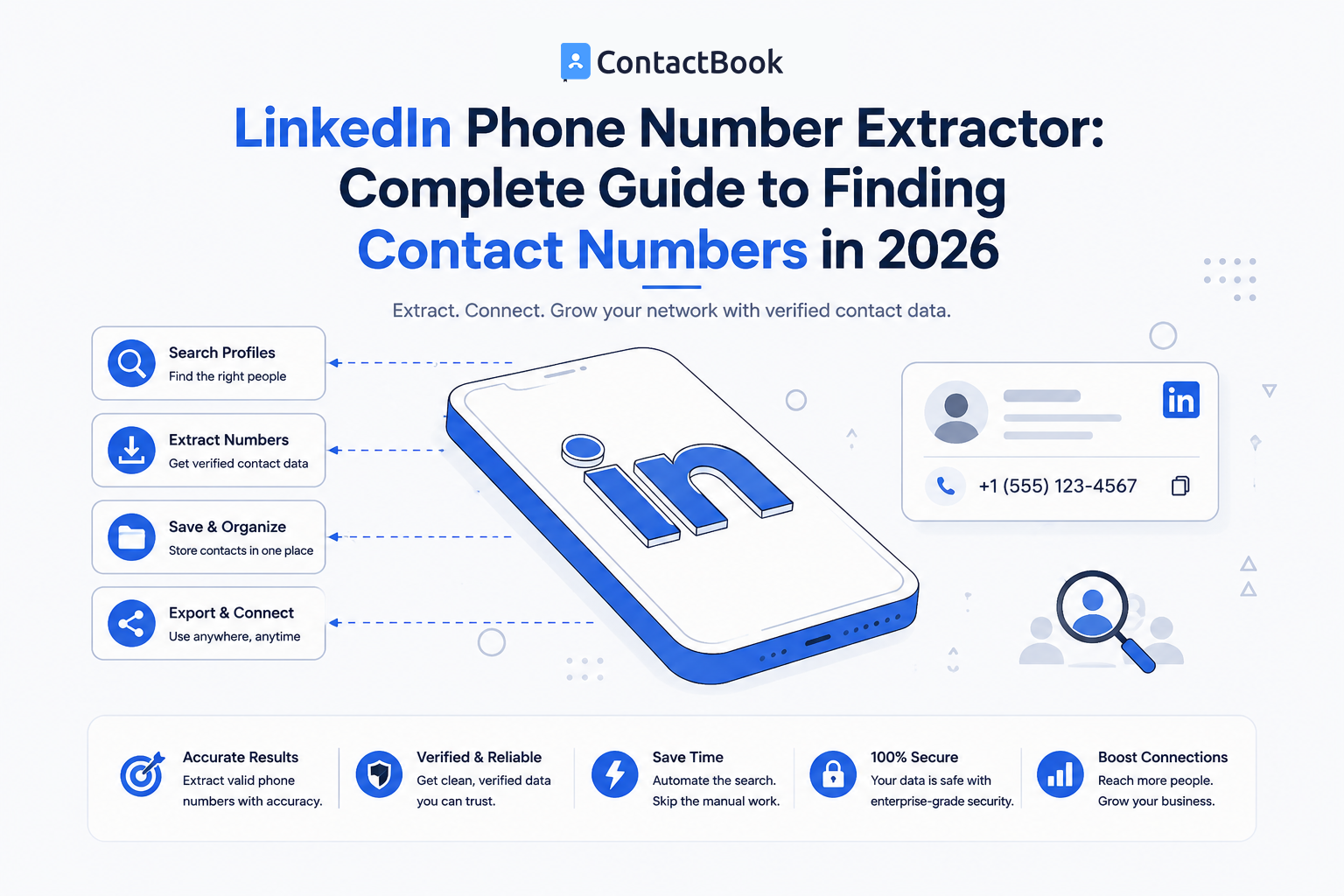
LinkedIn is one of the most valuable platforms for finding professionals, decision-makers, potential clients, recruiters, partners, and other business contacts.
Finding the right person, however, is only the beginning.
You may find the perfect prospect on LinkedIn but still need a reliable way to contact them outside the platform. That is why professionals often search for a LinkedIn phone number extractor or contact finder.
These tools and workflows can help users identify available contact information, reduce manual research, and move relevant professional connections into a more organized contact-management process.
But there is an important distinction to understand.
A LinkedIn profile does not automatically make someone's phone number available to everyone. The contact information you can access depends on what the person has provided, their privacy settings, your relationship with them, and the method used by the contact-discovery tool. LinkedIn itself notes that members control information in their Contact Info section and that visibility can vary.
So how does a LinkedIn contact number extractor actually work, and what is the best way to use one in 2026?
Let's break it down.
What Is a LinkedIn Phone Number Extractor?
A LinkedIn phone number extractor is generally a tool or workflow designed to help professionals obtain or capture available contact information associated with people they discover through LinkedIn.
Depending on the tool, the information may include:
- Full name
- Job title
- Company
- LinkedIn profile URL
- Business email address
- Phone or mobile number
- Location
- Company information
- Other professional details
Not every phone number extractor from LinkedIn works in the same way.
Some tools simply help save information that you can already see. Others use separate business databases or data-enrichment systems to match a LinkedIn profile with additional professional contact information.
That difference matters when evaluating accuracy, privacy, reliability, and the usefulness of the data.
Can You Find a Phone Number Directly on LinkedIn?
Sometimes.
LinkedIn allows users to add information such as an email address, phone number, website, and other details to their Contact Info section. However, the person controls what information they provide and who can see it.
Check the Contact Info Section
When viewing a LinkedIn profile, look for Contact info near the person's introduction section.
Depending on your connection with the person and their privacy settings, you may be able to see contact details they have chosen to provide.
If the number is available there, you do not necessarily need a separate LinkedIn mobile number extractor.
The challenge begins when you are researching tens, hundreds, or even thousands of potential business contacts.
Manually opening profiles, copying names, saving numbers, adding company information, and maintaining spreadsheets quickly becomes inefficient.
This is where contact-discovery and contact-management tools become useful.
How Does a LinkedIn Phone Number Extractor Work?
There is no single technical method used by every LinkedIn number extractor.
In practice, most solutions fall into a few broad categories.
1. Capturing Available Profile Information
Some tools help users capture information that is already accessible while reviewing a profile.
Instead of manually copying:
Name → Spreadsheet
Company → Spreadsheet
Phone → Spreadsheet
Email → Spreadsheet
LinkedIn URL → Spreadsheet
the information can be saved into a contact-management system more efficiently.
This primarily solves a workflow problem.
2. Contact Data Enrichment
Other platforms use contact enrichment.
Rather than relying exclusively on information visible on LinkedIn, an enrichment platform may use professional data sources to associate a person's name, company, job role, or profile with available business contact details.
This is why two phone-number finder tools can produce different results for the same person.
Their underlying databases, matching processes, geographic coverage, update frequency, and verification methods may differ.
We'll explore this process in more detail in our guide to LinkedIn data enrichment.
3. Contact Organization
Finding a number is only useful if your team can do something with it.
After finding a prospect, businesses usually need to:
- Save the contact
- Add context
- Categorize the lead
- Share it with teammates
- Record relevant notes
- Set a follow-up
- Update information when something changes
This is where a contact-management platform becomes important.
A list containing 2,000 extracted contacts without structure can quickly become just another spreadsheet nobody wants to maintain.
How to Find a Phone Number From LinkedIn
There are several ways to approach contact discovery.
Step 1: Identify the Right Person
Start with LinkedIn search or your existing professional network.
Confirm information such as:
- Name
- Current company
- Job position
- Location
- Industry
Before searching for someone's phone number, make sure you have identified the correct individual.
A common problem with contact databases is incorrect matching between people with similar names.
Step 2: Check Their Available Contact Information
Open the person's profile and check the Contact Info section.
If the person has chosen to make relevant information available to you, this is usually the simplest starting point.
Step 3: Use a Contact Finder When Necessary
If the contact information you need is not available directly, businesses sometimes use professional contact-finder or enrichment services.
Different tools are built for different workflows.
For example, you may prefer a free LinkedIn phone number extractor when researching a small number of prospects.
Someone who spends most of the day prospecting from a browser may prefer a LinkedIn phone number extractor Chrome extension.
Sales teams working with larger prospect lists may instead combine LinkedIn Sales Navigator with a contact enrichment workflow.
There is no single solution that is ideal for every team.
Step 4: Verify Important Contact Information
A phone number returned by a tool should not automatically be treated as guaranteed to be correct.
People:
- Change companies
- Change positions
- Change phone numbers
- Move locations
- Use separate personal and business numbers
For high-value prospects, verification is worth the extra effort.
Step 5: Save the Contact With Context
Do not stop after finding the number.
Save useful information explaining who the person is and why they matter.
For example:
Name: Alex Morgan
Company: Example Technologies
Role: Head of Partnerships
Source: LinkedIn
Tag: Partnership Prospect
Note: Met during SaaS networking event
Reminder: Follow up next Thursday
This turns a random phone number into a usable professional relationship.
Different Types of LinkedIn Contact Finder Tools
Choosing the right solution depends heavily on your workflow.
Free LinkedIn Phone Number Extractors
Free tools can be helpful if you only need occasional contact discovery.
They are particularly useful for:
- Freelancers
- Founders
- Small sales teams
- Recruiters with limited prospecting needs
- Professionals testing contact-finder workflows
Free products commonly have usage limits, fewer enrichment credits, restricted exports, or limited verification features.
Our guide to the best free LinkedIn phone number extractor tools compares these options in more detail.
LinkedIn Phone Number Extractor Chrome Extensions
Browser extensions are designed to reduce switching between applications.
Instead of copying information from a LinkedIn profile and pasting it somewhere else, an extension may allow relevant information to be captured during the prospecting workflow.
This approach is particularly useful for professionals who research individual prospects rather than processing large databases.
See our comparison of the best LinkedIn phone number extractor Chrome extensions for a closer look at this category.
LinkedIn Sales Navigator Contact Finders
LinkedIn Sales Navigator helps sales professionals identify and research prospects using more advanced search capabilities.
However, finding a relevant decision-maker and obtaining external contact information are separate problems.
That is why some sales teams combine Sales Navigator research with contact discovery, enrichment, and contact-management workflows.
We cover the complete process separately in how to get contact numbers from LinkedIn Sales Navigator.
Email and Phone Number Finders
Sometimes a phone number alone is not enough.
Sales teams may want multiple ways to contact a prospect depending on the relationship and situation.
Contact discovery platforms may therefore help users work with information such as:
- Email addresses
- Business phone numbers
- Company information
- LinkedIn profiles
Our guide on how to find email and phone numbers from LinkedIn covers this wider workflow.
What Should You Look for in a LinkedIn Phone Number Extractor?
Do not choose a tool simply because it promises large quantities of phone numbers.
Consider the quality of the overall workflow.
Accuracy
Incorrect data wastes more time than missing data.
Look for tools that provide useful verification or data-quality information rather than simply returning the largest possible number of results.
Data Freshness
Professional information changes constantly.
Someone listed as a sales director at one company today may work somewhere completely different several months later.
Fresh data is therefore essential.
Ease of Use
If finding one contact requires six different tools and ten browser tabs, the process will eventually become difficult to maintain.
The best workflow should minimize unnecessary manual work.
Contact Management
Ask what happens after the contact is discovered.
Can your team:
- Organize contacts?
- Add tags?
- Add notes?
- Create groups?
- Share contacts?
- Keep information updated?
- Set reminders?
Contact discovery and contact management should work together.
Privacy and Platform Rules
This is especially important in 2026.
LinkedIn's current guidance states that unauthorized third-party tools that scrape, copy, or automate activity on the platform can violate its rules.
Businesses should therefore understand how a particular tool obtains information and ensure that their prospecting practices comply with LinkedIn's terms and applicable privacy and outreach regulations.
A good prospecting strategy is not simply about obtaining as much data as possible. It is about using relevant business information responsibly.
Finding Contacts Is Only Half the Problem
Imagine your sales team discovers 300 valuable prospects this month.
Employee A saves 80 contacts in a spreadsheet.
Employee B saves 60 on their phone.
Employee C has another 100 sitting inside LinkedIn.
A manager maintains a different spreadsheet containing older prospect information.
The company technically has plenty of contacts.
But it does not have a usable contact database.
That is why contact management matters just as much as contact discovery.
How ContactBook Helps
ContactBook is built around centralizing, organizing, managing, and sharing contacts rather than leaving valuable relationships scattered across personal address books and spreadsheets.
Its website highlights capabilities including shared contacts, tags, notes, reminders, permissions, real-time updates, mobile access, and centralized contact management.
ContactBook also promotes a Chrome-extension workflow for capturing contact information from the web and storing it directly in ContactBook.
The bigger advantage of this approach is what happens after a professional contact has been discovered.
Instead of ending with a phone number, you can create an organized contact record that your team can continue using.
That means a LinkedIn connection can become:
LinkedIn Profile → Contact → Tagged Prospect → Shared Contact → Follow-Up → Business Relationship
For sales teams, recruiters, consultants, agencies, real-estate professionals, founders, and other relationship-driven businesses, that process is often more valuable than extraction alone.
LinkedIn Contact Discovery vs Contact Management
These two processes solve different problems.
Contact discovery answers:
“How can I find this person's professional contact information?”
Contact management answers:
“Now that we have this contact, how do we make sure our team can actually use and maintain it?”
Successful prospecting requires both.
Finding thousands of numbers without organization creates contact chaos.
Perfect organization without a steady flow of relevant prospects limits growth.
The strongest workflow connects discovery with long-term relationship management.
Frequently Asked Questions
Can I extract a phone number from LinkedIn?
You may be able to access phone information that a LinkedIn member has chosen to provide and that their visibility settings allow you to see. Other contact-discovery platforms may use separate enrichment databases to identify professional contact information.
Is there a free LinkedIn phone number extractor?
There are contact-finder tools that provide free plans, trials, or limited free credits. However, free versions commonly limit the number of searches, phone numbers, exports, or enrichment requests available.
Can I find someone's phone number through LinkedIn Sales Navigator?
Sales Navigator primarily helps professionals identify and research prospects. If contact information is not available through the person's accessible profile information, teams may use separate contact-discovery or enrichment workflows.
What is a LinkedIn contact number extractor Chrome extension?
It is generally a browser-based tool designed to make contact discovery or contact capture easier while researching professionals online. Capabilities vary considerably between extensions, so users should review data sources, accuracy, privacy practices, and platform compliance before using one.
Can a LinkedIn phone number extractor find every person's number?
No. No responsible tool should be expected to find an accurate phone number for every LinkedIn profile. Availability depends on the information accessible to the user, the data sources used by the tool, geographic coverage, and whether accurate contact information exists in its databases.
What should I do after finding LinkedIn contacts?
Organize them immediately. Save the contact's name, company, position, contact information, source, notes, tags, and follow-up information in a contact-management system so the relationship does not disappear inside a spreadsheet or personal account.
Final Thoughts
A LinkedIn phone number extractor can make professional contact discovery faster, but finding a phone number should never be the entire strategy.
The real objective is to turn the right professional connections into organized, usable business relationships.
Start by identifying relevant people on LinkedIn. Check the contact information available to you. Use appropriate contact-discovery tools when needed. Verify important details. Then move those contacts into a system where they can be categorized, shared, updated, and followed up consistently.
That is where tools such as ContactBook fit into the wider workflow.
Rather than allowing valuable contacts to remain scattered across LinkedIn, personal phones, browser tabs, and spreadsheets, businesses can create one organized place where the right people have access to the right contacts.
Ready to organize your professional network? Explore ContactBook and turn scattered connections into contacts your team can actually manage.

.png)

.svg)


.svg)