The Contact Management Stack: What 7-Figure Businesses Actually Use in 2026

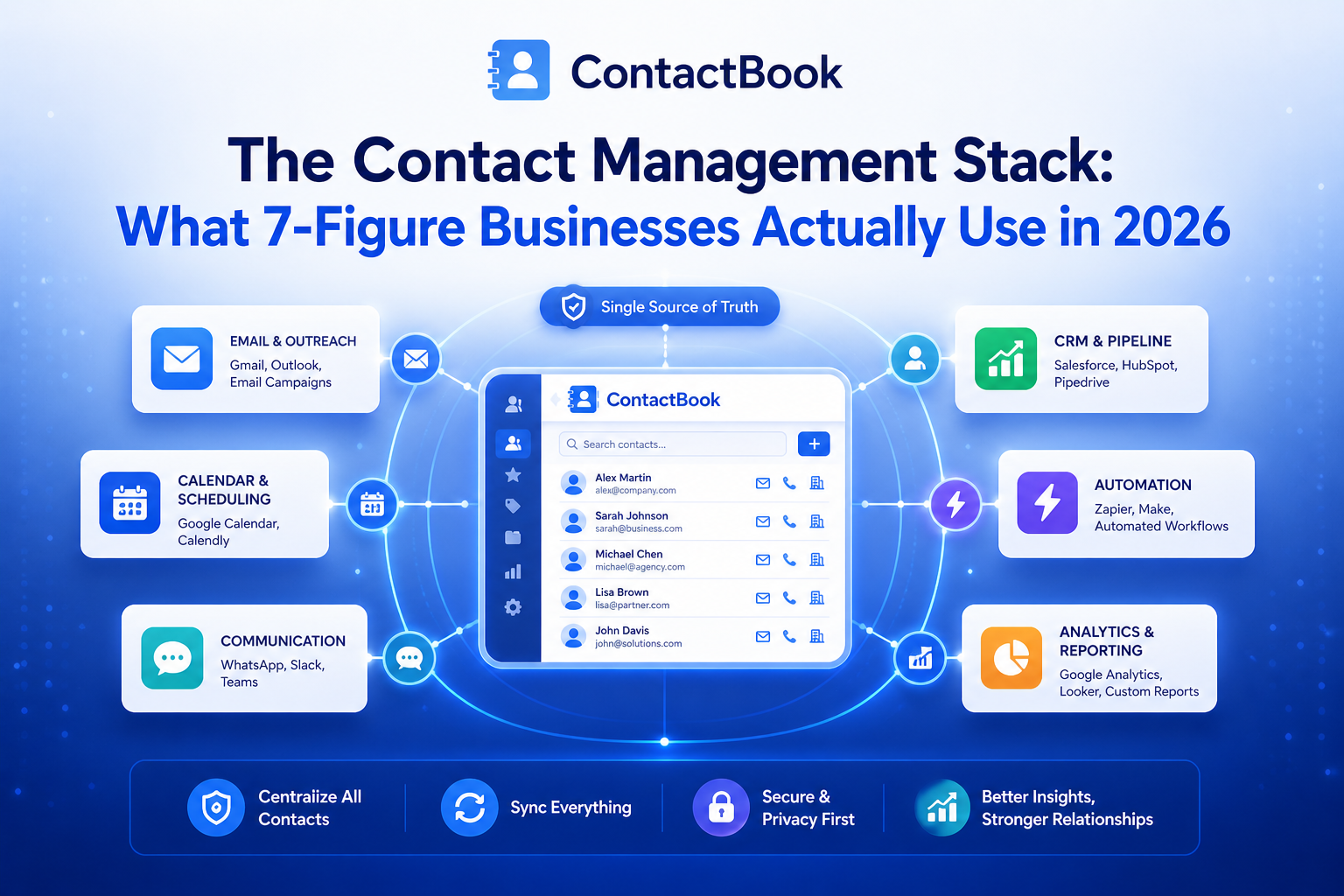
What a Modern Contact Stack Looks Like in 2026
As businesses scale, contacts stop being “just data.”
They become:
- Revenue drivers
- Relationship assets
- Operational dependencies
But here’s where most teams struggle they don’t have a system. They have scattered tools.
7-figure businesses solve this differently.
They build a contact management stack a structured system where contacts are:
- Centralized
- Enriched with context
- Accessible across teams
- Integrated into daily workflows
If your contacts still live across spreadsheets, inboxes, and personal devices, you’re not running a stack you’re running chaos. This is exactly the kind of situation described in contact chaos in growing businesses (see blog #25).
Why CRM Alone Isn’t Enough
Many teams assume a CRM solves everything.
It doesn’t.
CRMs are designed for:
- Sales pipelines
- Deal tracking
- Forecasting
But they often fall short when it comes to:
- Personal relationship tracking
- Internal team contact sharing
- Real-time contact updates outside sales workflows
That’s why high-growth teams don’t rely on CRM alone they complement it.
If you’re trying to choose the best contact management app (see blog #32), you’ll notice that modern teams separate contact management from sales tracking.
The 5 Core Layers of a High-Performing Contact Stack
Here’s what a real contact stack looks like in 2026:
1. Central Contact Hub
A single source of truth for all contacts.
This is where tools like ContactBook come in giving teams a shared, structured, and searchable contact database.
2. Communication Layer
Email, calls, WhatsApp, and other channels where interactions happen.
The key is not just communication but ensuring contact data stays updated alongside it. Many teams struggle with this, especially when managing WhatsApp business contacts (see blog #37).
3. Context & Enrichment Layer
Contacts without context are almost useless.
Top teams enrich contacts with:
- Notes
- Tags
- Interaction history
- Relationship insights
This is what transforms a list into a system similar to how founders organize their networks (see blog #23).
4. Collaboration Layer
Contacts shouldn’t live with individuals they should belong to the business.
A strong stack ensures:
- Team-wide access
- Clear ownership
- No duplication
- No dependency on a single person
Without this, teams run into shared contact management challenges (see blog #22).
5. Automation & Intelligence Layer
Modern systems don’t just store they assist.
This includes:
- Auto-updating contact details
- Filling missing information
- Smart categorization
If you're exploring how this works, check how teams auto-fill missing contact details using AI (see blog #38).
How High-Growth Teams Actually Use This Stack
The difference isn’t just in tools it’s in usage.
7-figure teams:
- Don’t waste time searching for contacts
- Don’t rely on memory or personal devices
- Don’t duplicate outreach
- Don’t lose contacts when employees leave
Instead, they:
- Access contacts instantly
- Track every interaction
- Maintain continuity across teams
- Turn every contact into a long-term asset
This is why they don’t struggle with relationship continuity (see blog #27).
Building Your Own Contact Stack Without Overcomplicating It
You don’t need 10 tools.
You need the right structure.
Step 1: Centralize Contacts
Move away from scattered storage into a single platform like ContactBook.
Step 2: Clean Your Data
Remove duplicates and inconsistencies. If your data is messy, start by learning how to remove duplicate contacts effectively (see blog #18).
Step 3: Add Context
Make every contact meaningful with notes, tags, and history.
Step 4: Enable Team Access
Ensure contacts are shared, not siloed.
Step 5: Layer Tools Around It
Only add tools where necessary don’t overbuild.
Also, avoid the trap of overpaying for contact management tools (see blog #20). A simple, well-structured system outperforms a bloated stack.
Why ContactBook Sits at the Center of This Stack
At the core of every effective contact stack is a central contact system.
ContactBook is designed to play that role.
It helps you:
- Centralize all contacts in one place
- Organize them with tags and notes
- Share access across teams
- Maintain updated and structured data
- Reduce dependency on individual team members
Instead of juggling tools, it gives you a foundation to build on.
Final Thoughts: Systems Win, Not Tools
Most businesses don’t fail because they lack contacts.
They fail because they lack systems.
A strong contact management stack ensures:
- No relationship is lost
- No opportunity is missed
- No team member works in isolation
If you're still managing contacts across disconnected tools, now is the time to fix it.
Because in 2026, the advantage doesn’t go to the company with more contacts
it goes to the one that manages them better.

.png)


.svg)


.svg)