The Contact System Mistake That Turns Investors Away

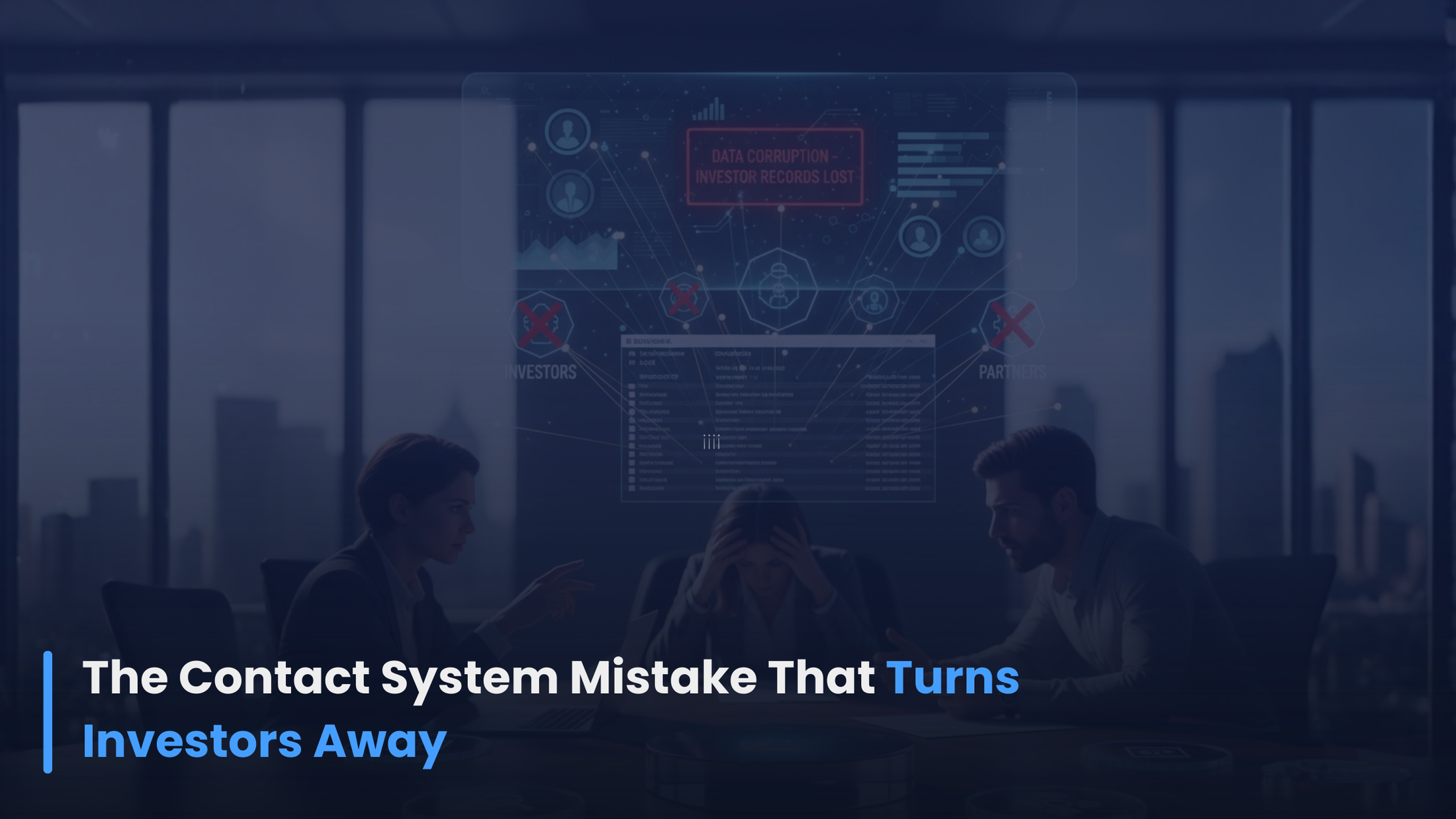
Raising capital is hard enough without sabotaging yourself through poor contact management. Yet every day, founders and fund managers lose investor confidence—not because of weak business models or poor market timing, but because their contact systems signal operational incompetence.
Investors don't just evaluate your pitch deck, financial projections, or team credentials. They're constantly assessing whether you can execute. And nothing reveals execution capability faster than how you manage relationships and communications.
When your contact management is chaotic, investors notice. And they walk away.
Why First Impressions Matter More Than You Think in Fundraising
You get one chance to make a first impression with an investor. Most founders obsess over perfecting their pitch while completely overlooking how their operational systems appear to potential backers.
Here's what investors see when they interact with you:
- Do you remember previous conversations or ask the same questions twice?
- Do you follow up promptly on commitments made during meetings?
- Does your team coordinate seamlessly or contradict each other?
- Can you quickly surface relevant information when asked?
- Do you track investor preferences and communication history?
These aren't trivial details. They're signals about your ability to manage a complex, growing business.
An investor who receives duplicate emails from your team, gets asked questions you've already discussed, or experiences forgotten follow-ups doesn't think: "They're just busy."
They think: "If they can't manage basic relationship tracking during fundraising when they're trying to impress me—what happens when they're managing my capital and facing real operational pressure?"
First impressions aren't just about your pitch. They're about your systems.
The Fatal Contact Management Errors That Kill Investor Confidence
Poor contact management doesn't just create minor inconveniences. It destroys investor confidence in ways that are difficult to recover from.
The Duplicate Outreach Disaster
Monday morning: Your co-founder emails an investor introducing your fundraise.
Tuesday afternoon: You email the same investor with the same introduction, completely unaware your co-founder already reached out.
The investor's reaction: "This team doesn't even communicate internally. How will they coordinate a complex business?"
The deal is effectively dead. Not because of your product or market opportunity, but because you looked disorganized and unprofessional.
The Forgotten Conversation Problem
An investor spends 45 minutes on a call with you discussing their specific concerns about your go-to-market strategy. You promise to send additional data addressing their questions.
Two weeks later, you follow up with a generic update that doesn't reference the conversation or address what they asked about.
Message sent: "I'm not important enough for them to remember our discussion or follow through on commitments."
Investors fund founders who demonstrate reliability. Forgotten conversations prove unreliability.
The Lost Context Failure
An investor introduces you to a potential customer or advisor as a favor. It's a valuable connection that could significantly help your business.
You never follow up, or worse, you follow up months later with no acknowledgment of the introduction or update on the outcome.
Message sent: "They don't value my network or the effort I put into helping them."
Investors want to back founders who leverage opportunities effectively. Lost context demonstrates the opposite.
The Information Inconsistency Issue
One team member tells an investor your burn rate is $150K/month. Another mentions it's $200K/month. Your pitch deck shows $175K/month.
The investor's conclusion: "Either they don't know their own numbers, or they're being deliberately unclear. Neither is acceptable."
Inconsistent information doesn't just raise questions about your contact management—it raises questions about your integrity and financial controls.
When Disorganization Signals Bigger Operational Problems
Investors don't just fund ideas. They fund execution capability. Your contact management is a window into your operational competence.
What Poor Contact Systems Reveal
Lack of attention to detail: If you can't track basic relationship information, how will you manage complex product development, financial planning, or customer success operations?
Poor team coordination: If your founding team can't coordinate outreach to a handful of investors, how will you coordinate a company with 50 employees across multiple functions?
Inability to scale systems: If your contact management breaks down with 20 investors, what happens when you have 200 customers, 50 partners, and 500 stakeholders?
Reactive rather than strategic: If you're scrambling to remember who you talked to and what you discussed, you're operating reactively. Investors fund strategic operators, not reactive firefighters.
The Pattern Investors See
Experienced investors have seen hundreds of startups. They recognize patterns.
When they see poor contact management, they don't just see an isolated problem. They see a pattern that predicts future operational failures:
- The startup that can't track investor communications also can't track customer conversations
- The team that forgets follow-up commitments also misses product deadlines
- The founders who duplicate outreach also duplicate work internally
- The company with inconsistent information also has inconsistent processes
Your contact management isn't separate from your business operations—it's a preview of them.
How Investors Evaluate Your Systems Before Writing Checks
Smart investors conduct operational due diligence alongside financial and market diligence. They're assessing whether you have the systems to execute on your vision.
What They're Watching For
Response time and reliability: Do you follow up promptly? Do you deliver what you promise when you promise it?
Information consistency: Do all team members tell the same story? Are your numbers consistent across conversations and materials?
Communication coordination: Does your team seem aligned and coordinated, or chaotic and contradictory?
Relationship management: Do you remember previous conversations? Do you track preferences and tailor communications accordingly?
Follow-through capability: When you commit to sending additional information or making introductions, does it actually happen?
The Questions They're Asking Internally
After interacting with you, investors ask themselves:
- "Can this team manage the complexity of scaling a business?"
- "Will they be responsive and reliable as portfolio companies?"
- "Do they have the operational discipline to hit milestones?"
- "Will managing this investment require constant hand-holding?"
Your contact management directly influences how they answer these questions.
The Double Contact Disaster That Destroys Credibility
Nothing kills credibility faster than multiple people from your team contacting the same investor without coordination.
Why This Happens
Scattered contact lists: Each team member maintains their own list of investor contacts and outreach tracking.
No visibility into team activity: Nobody knows who's reaching out to whom or when.
Lack of ownership clarity: No clear assignment of which team member owns which investor relationship.
No communication protocols: No system for logging outreach and coordinating follow-up.
The Impact
When an investor receives duplicate outreach, they immediately question:
- Your team's ability to communicate internally
- Your organizational systems and processes
- Your attention to detail and professionalism
- Your readiness to manage investor capital responsibly
The damage is often irreversible. You might get a polite pass, but you've lost credibility that's nearly impossible to rebuild.
The Solution
Centralized investor contact management where:
- All investor contacts live in one shared system
- All team members can see who's been contacted and when
- Clear ownership is assigned for each investor relationship
- Communication history is logged and accessible
- Coordination happens automatically through visibility
Missing Follow-Ups and Forgotten Conversations Cost You Deals
Fundraising is a long sales cycle with multiple touchpoints over weeks or months. Forgotten follow-ups kill deals that could have closed.
The Follow-Up Gap
Common scenario:
An investor expresses interest but wants to see traction in a specific metric before committing. They tell you to follow up in 60 days when you have updated numbers.
Without a systematic reminder, 60 days pass. You don't follow up. The investor assumes you didn't hit your targets or lost interest. The opportunity dies.
Alternative scenario:
You have a systematic contact management system with automated reminders. On day 58, you get an alert to prepare your updated metrics. On day 60, you follow up with impressive progress. The investor moves forward with term sheet discussions.
The difference: A systematic approach to relationship maintenance versus hoping you'll remember.
The Conversation Context Problem
Investors have dozens of active conversations with founders. They don't remember the details of your specific situation unless you reference them.
Generic follow-up: "Just wanted to check in on our fundraise."
Contextualized follow-up: "Following up on our conversation three weeks ago where you mentioned wanting to see our customer acquisition cost drop below $200. We've hit $185 and wanted to share the updated metrics."
The second approach demonstrates you value the relationship, remember the conversation, and are responsive to their specific concerns.
This requires contact management that captures conversation context and surfaces it when needed.
Why Scattered Investor Data Creates Compliance Nightmares
Beyond losing investor confidence, poor contact management creates legal and compliance risks during and after fundraising.
Regulatory Documentation Requirements
Securities regulations require documentation of investor communications, representations made, and information provided.
When investor contact data is scattered across:
- Personal email accounts
- Individual team member phones
- Disconnected spreadsheets
- Random note-taking apps
You cannot:
- Produce complete communication records if required
- Demonstrate proper disclosure and compliance
- Protect yourself in investor disputes
- Maintain audit trails for regulatory review
The Due Diligence Problem
When investors conduct their own due diligence, they may request documentation of your fundraising process, investor communications, and information sharing.
Inability to produce organized, complete records signals operational weakness and creates legal exposure.
The Data Security Risk
Investor information is sensitive. Names, contact details, investment amounts, and communications must be protected.
Storing this data in unsecured spreadsheets, personal email, or individual devices creates:
- Data breach vulnerability
- Privacy regulation violations
- Professional liability exposure
- Reputational risk
Proper contact management isn't just operational—it's legal protection.
What Professional Contact Management Signals to Investors
When you demonstrate organized, systematic contact management, you send powerful positive signals.
Operational Excellence
Investors notice when you:
- Remember details from previous conversations
- Follow up promptly on commitments
- Coordinate seamlessly across your team
- Surface relevant information quickly
- Track preferences and tailor communications
The message: "This team has their act together operationally."
Respect for Relationships
Professional contact management demonstrates:
- You value the investor's time
- You take their feedback seriously
- You're organized and reliable
- You operate with attention to detail
The message: "They'll treat our capital with the same care they treat these relationships."
Scalability Readiness
When your systems are professional:
- Investors see you're ready to scale
- They trust you can manage growth complexity
- They believe you'll be a low-maintenance portfolio company
The message: "This team is ready for the next stage."
Building Investor Trust Through Operational Excellence
Trust isn't built through pitch decks alone. It's built through consistent, professional execution in every interaction.
The Contact Management Practices That Build Trust
Complete interaction tracking: Log every call, meeting, email, and commitment in a centralized system accessible to your entire team.
Systematic follow-up: Set reminders for follow-up actions and never let commitments fall through the cracks.
Team coordination: Ensure everyone knows who's managing which investor relationships and what conversations have occurred.
Context preservation: Capture details about investor preferences, concerns, questions, and areas of interest for future reference.
Consistent information: Ensure all team members work from the same data and present consistent information.
Responsive communication: Demonstrate reliability by following through on every commitment made during investor conversations.
The Compounding Effect
Each professional interaction builds on the previous one:
- First interaction: They notice you're organized
- Second interaction: They appreciate your follow-through
- Third interaction: They trust your operational capability
- Fourth interaction: They're ready to write a check
Trust compounds through consistent operational excellence in every touchpoint.
Turning Contact Organization Into a Competitive Fundraising Advantage
Most founders treat contact management as an afterthought. The ones who systemize it gain significant competitive advantage.
The Advantages of Superior Contact Systems
Faster fundraising cycles: When you can quickly surface relevant information, coordinate team responses, and maintain systematic follow-up, fundraising moves faster.
Higher conversion rates: Investors who experience professional, coordinated interactions are more likely to convert from interest to commitment.
Stronger investor relationships: Organized contact management enables personalized, context-rich communications that build deeper relationships.
Better terms: When multiple investors are engaged and moving forward simultaneously (because you haven't dropped balls), you have better negotiating leverage.
Easier future raises: Systematic investor relationship management means your existing investors are warm and ready for follow-on rounds.
The Long-Term Impact
Fundraising isn't a one-time event. The investor relationships you build during this raise become:
- Follow-on investors for future rounds
- Introducers to other investors
- References for partnerships and customer deals
- Advisors and supporters throughout your journey
Professional contact management compounds in value over years, not just during active fundraising.
Your Contact System Is Your Credibility
Investors see hundreds of pitches. Most founders have good ideas. Many have compelling markets. What separates fundable companies from everyone else?
Execution capability.
And nothing signals execution capability—or lack thereof—faster than how you manage investor relationships and communications.
When you demonstrate:
- Systematic contact organization
- Team coordination and communication
- Reliable follow-through
- Attention to detail
- Professional relationship management
Investors think: "This team can execute. They'll manage my capital with the same discipline they manage these relationships."
When you demonstrate:
- Scattered, disorganized contact tracking
- Duplicate outreach and poor coordination
- Forgotten conversations and missed follow-ups
- Inconsistent information across team members
- Reactive, chaotic relationship management
Investors think: "If they can't manage basic contact organization during fundraising—when they're trying to impress me—they definitely can't manage the complex operations of a growing business."
Your Systems Speak Louder Than Your Pitch
You've worked hard on your product, your business model, your team, and your pitch. Don't let poor contact management undermine everything you've built.
Before your next investor meeting, ask yourself:
- Can my entire team see our complete investor contact history?
- Do we have systematic follow-up reminders for every commitment?
- Are we coordinating outreach to prevent duplicate contacts?
- Do we capture and reference context from previous conversations?
- Can we quickly surface relevant information when investors ask?
If you can't confidently answer yes to all these questions, your contact management is costing you deals.
The investment in proper contact organization pays for itself with a single successful fundraise. The cost of poor contact management is lost investor confidence you can never fully recover.
Build the systems that signal you're ready for investor capital. Because in fundraising, your contact management isn't just about organization—it's about credibility.
Don't let scattered spreadsheets and forgotten follow-ups cost you the funding your business deserves.
Build the contact systems that turn investors into believers.

.png)


.svg)


.svg)