Why Recruitment Agencies Keep Re-Sourcing Candidates They Already Know

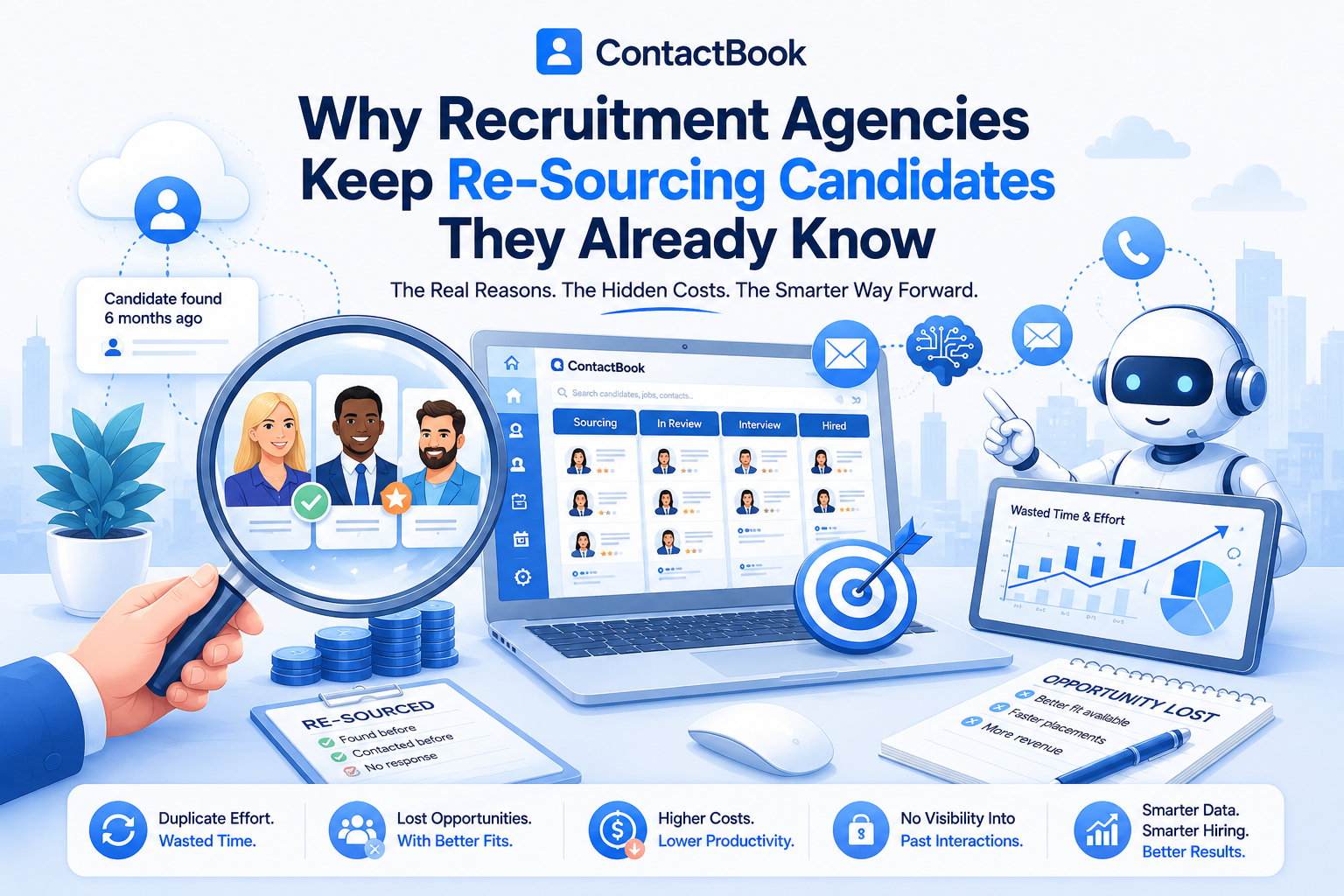
The Hidden Cost of Starting Every Search from Scratch
A new role lands in a recruiter's inbox.
The hiring manager needs candidates quickly. The clock starts ticking. The recruiter opens LinkedIn Recruiter, searches job boards, and begins sourcing prospects.
Hours later, a shortlist starts taking shape.
But here's the uncomfortable truth: many of those candidates may already exist somewhere within the agency's network.
They may have applied for a similar role six months ago. A colleague may have interviewed them last year. They might have been referred by a client, attended a networking event, or even been placed in a previous role.
Yet recruiters often fail to rediscover these candidates when new opportunities arise.
This isn't a sourcing problem. It's a visibility problem.
Across the recruitment industry, agencies are sitting on years of candidate relationships, conversations, referrals, and interactions. However, much of this valuable information remains scattered across ATS platforms, spreadsheets, email inboxes, LinkedIn connections, and personal notes.
As a result, recruiters repeatedly invest time sourcing candidates they already know instead of leveraging the talent network they've already built.
In an industry where speed, relationships, and efficiency drive revenue, this hidden challenge can have a significant impact on productivity and placement success.
Why Candidate Data Gets Lost
Most recruitment agencies don't struggle to collect candidate data.
In fact, they often collect too much of it.
Every day, recruiters add new resumes, LinkedIn profiles, referrals, and contacts to their systems. Over the years, databases grow into thousands—or even hundreds of thousands—of records.
The challenge is not gathering information. The challenge is organizing it.
Candidate data typically lives across multiple locations:
- Applicant Tracking Systems (ATS)
- Spreadsheets
- Email conversations
- LinkedIn connections
- Internal notes
- CRM platforms
- Shared documents
- Personal contact lists
When information is fragmented, it becomes difficult to locate the right candidate at the right time.
A recruiter searching for a software engineer may not realize another recruiter within the agency spoke with a highly qualified candidate just months earlier.
Similarly, a candidate who was not suitable for one role may be perfect for a new opportunity, but without visibility into past interactions, that connection remains hidden.
Over time, agencies accumulate a wealth of candidate knowledge that becomes increasingly difficult to access.
The Business Impact of Re-Sourcing Candidates
Repeatedly sourcing candidates that already exist within your network might seem like a minor inefficiency.
In reality, it creates a chain reaction that affects productivity, candidate experience, and revenue.
Lost Recruiter Time
Recruiters are among the most valuable assets within an agency. Their time should be spent building relationships, engaging talent, and closing placements.
When recruiters repeatedly conduct searches for candidates already in the database, hours are wasted on duplicate work.
Multiply that across an entire recruitment team, and the productivity loss becomes substantial.
Longer Time-to-Fill
Clients expect agencies to move quickly.
The longer it takes to identify suitable candidates, the longer positions remain open.
Agencies that cannot efficiently rediscover existing talent often spend days or weeks sourcing candidates they could have contacted immediately.
This slows down the hiring process and can impact client satisfaction.
Missed Revenue Opportunities
Every delayed placement represents potential revenue left on the table.
If recruiters struggle to access qualified candidates already within their network, opportunities may be lost to competitors who can respond faster.
Poor Candidate Experience
Candidates don't enjoy receiving multiple outreach messages from the same agency over time because previous interactions were forgotten.
Repeated outreach without context can make agencies appear disorganized and damage long-term relationships.
The Myth That More Sourcing Solves Everything
Recruitment technology has evolved dramatically over the past decade.
Today, recruiters have access to powerful sourcing tools, job boards, talent marketplaces, and AI-powered search platforms.
Yet many agencies continue to focus primarily on acquiring new candidates rather than maximizing the value of existing relationships.
This creates a common misconception:
"If we're not finding enough candidates, we need more sourcing."
In reality, many agencies already possess extensive talent networks. The issue is that those networks are not easily searchable, accessible, or organized.
The most successful recruiters understand that recruitment is fundamentally a relationship-driven business.
The strength of an agency often depends not on how many new candidates it finds but on how effectively it manages the relationships it already has.
Why Spreadsheets Become a Bottleneck
For many growing agencies, spreadsheets initially seem like a practical solution.
They're simple, familiar, and inexpensive.
However, as candidate databases expand, spreadsheets begin to create challenges rather than solve them.
Common issues include:
- Duplicate entries
- Outdated contact information
- Lack of collaboration across teams
- Missing communication history
- Limited search functionality
- Manual updates
- Version control problems
A spreadsheet may tell you that a candidate exists.
It rarely tells you the full story.
What role were they interested in?
Who spoke with them?
When was the last interaction?
What skills were discussed?
What opportunities were they considering?
Without this context, recruiters lose valuable relationship intelligence that could accelerate placements.
The Rise of Candidate Rediscovery
Forward-thinking recruitment agencies are increasingly embracing a strategy known as candidate rediscovery.
Instead of starting every search from scratch, recruiters first explore their existing network to identify qualified candidates who may already be a strong fit.
Candidate rediscovery focuses on unlocking value from relationships that already exist.
This approach offers several advantages:
Faster Hiring Cycles
Recruiters can engage known candidates immediately instead of spending days sourcing new prospects.
Higher Response Rates
Candidates who already recognize the agency are often more likely to respond to outreach.
Stronger Relationships
Past interactions provide valuable context that helps recruiters have more meaningful conversations.
Better Database Utilization
Agencies maximize the return on years of sourcing, networking, and relationship-building efforts.
Rather than viewing their database as a storage system, successful agencies treat it as a strategic asset.
What Recruitment Agencies Need in 2026
As recruitment becomes more competitive and technology-driven, agencies need systems that go beyond basic contact storage.
Modern recruitment teams require solutions that help them:
Centralize Information
Bring candidate, client, and referral data into one accessible location.
Eliminate Data Silos
Ensure knowledge is shared across teams instead of remaining isolated with individual recruiters.
Improve Searchability
Make it easy to locate candidates based on skills, industry experience, location, and previous interactions.
Preserve Relationship History
Maintain context around every conversation and touchpoint.
Support Team Collaboration
Enable recruiters to work from a shared source of truth.
Prepare for Automation
Create structured, reliable data that can support future AI and workflow initiatives.
The agencies that invest in organized relationship data today will be better positioned to leverage automation and AI tomorrow.
How ContactBook Helps Recruitment Agencies Stay Organized
Recruitment success depends on relationships.
Yet many agencies struggle because valuable contacts become scattered across spreadsheets, inboxes, and disconnected systems.
ContactBook helps recruitment agencies create a centralized and searchable contact management system that keeps candidate and client relationships organized.
Instead of losing visibility into years of interactions, recruiters can maintain a clear view of their network, making it easier to rediscover talent, collaborate across teams, and engage the right people at the right time.
By improving contact organization and relationship visibility, agencies can reduce duplicate sourcing efforts and focus more energy on building meaningful connections that drive placements.
Final Thoughts
Many recruitment agencies believe they need more candidates.
In reality, they often need better visibility into the candidates they already know.
Years of sourcing, networking, referrals, and conversations create an incredibly valuable talent network. But without the right systems in place, that network becomes difficult to access and even harder to leverage.
The agencies that succeed in 2026 won't necessarily be those with the largest databases.
They'll be the ones that can quickly find, understand, and activate the relationships they've already built.
Because in recruitment, your next great placement may not be hiding on a job board.
It may already be sitting inside your network—waiting to be rediscovered.

.png)

.svg)


.svg)