Why Small Businesses Are Switching from Expensive CRMs to Lightweight Contact Tools

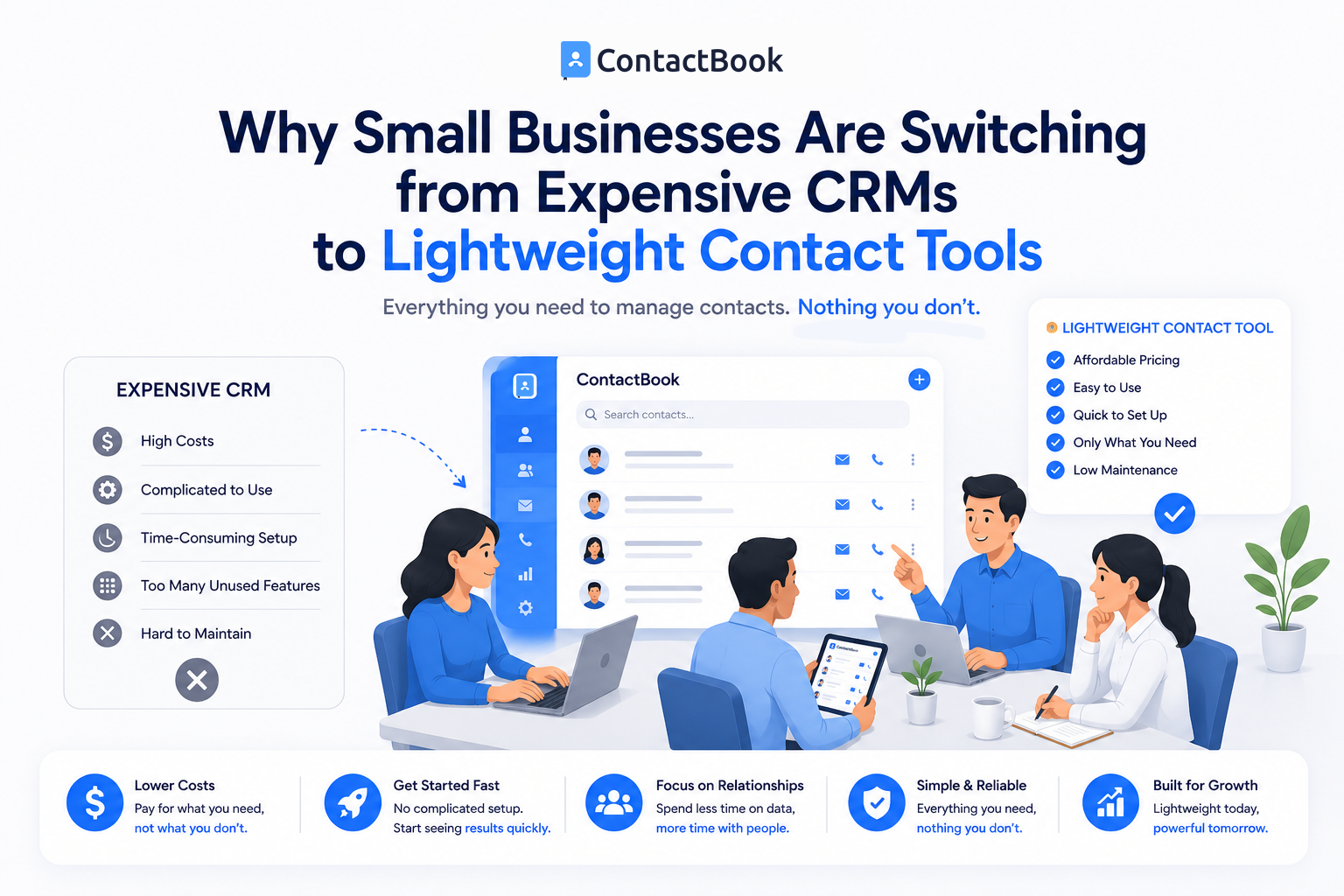
Customer relationships are the foundation of every successful small business. Whether you're managing clients, leads, suppliers, or business partners, having quick access to accurate contact information is essential. For years, many businesses turned to Customer Relationship Management (CRM) software to organize these relationships. However, not every business needs the complexity or cost of a full-scale CRM.
Today, more small businesses are choosing lightweight contact management tools instead of expensive CRM platforms. These solutions focus on what many growing businesses actually need—organizing, sharing, and managing contacts efficiently without overwhelming users with features they may never use.
In this article, we'll explore why this shift is happening, the advantages of lightweight contact tools, and how solutions like ContactBook help businesses simplify contact management while improving productivity.
Why Traditional CRM Systems Can Be Too Much for Small Businesses
CRM software offers many powerful features, including sales pipelines, forecasting, marketing automation, customer analytics, and reporting. While these capabilities benefit larger organizations, they often exceed the needs of small businesses.
Many small teams simply want an efficient way to manage business contacts, collaborate with coworkers, and keep information organized.
High Subscription Costs
One of the biggest reasons businesses move away from traditional CRM software is cost.
Many CRM platforms charge on a per-user basis, making them increasingly expensive as businesses grow. Additional costs for premium features, integrations, and storage can further increase monthly expenses, placing pressure on smaller budgets.
Complex Features That Go Unused
Many CRM systems include advanced capabilities that small businesses rarely need.
Sales forecasting, complex workflow automation, and detailed analytics are valuable for enterprise organizations but can make daily operations more complicated for smaller teams. As a result, employees often use only a small percentage of the software while still paying for the entire platform.
Longer Learning Curves
Feature-rich CRM platforms usually require training before employees can use them effectively.
Small businesses often prefer software that employees can learn quickly without extensive onboarding. Simpler tools reduce training time and help teams become productive faster.
What Are Lightweight Contact Management Tools?
Lightweight contact management tools are designed to help businesses organize, access, and share business contacts without the complexity of a full CRM system.
They focus on maintaining clean, centralized contact information while making collaboration easier for growing teams.
Simple Contact Organization
Instead of managing dozens of CRM modules, businesses can focus on organizing names, phone numbers, email addresses, company details, notes, tags, and contact groups.
This streamlined approach makes finding and updating information much easier.
Centralized Contact Access
A lightweight contact management tool stores all business contacts in one shared location.
Employees can quickly access updated information without searching through spreadsheets, personal address books, or email conversations. This improves communication across the entire organization.
Faster Daily Workflows
With fewer menus and unnecessary features, employees spend less time navigating software and more time communicating with customers and colleagues.
The result is a smoother workflow and higher productivity.
Why Small Businesses Prefer Lightweight Contact Tools
As businesses grow, they look for solutions that balance functionality with simplicity.
Lightweight contact management tools offer practical benefits that align with the everyday needs of small teams.
Lower Costs Without Sacrificing Essential Features
Small businesses appreciate software that solves real problems without requiring enterprise-level budgets.
By focusing on contact organization and collaboration instead of advanced sales management, lightweight tools provide better value for companies that don't need a full CRM.
Easier Team Collaboration
Business contacts should belong to the organization, not individual employees.
Shared contact lists allow teams to work from the same accurate information, reducing duplicate records and ensuring everyone communicates with customers consistently.
Improved Productivity
Employees no longer waste time maintaining multiple spreadsheets or searching for missing contact details.
Centralized contact management keeps information organized, helping teams respond faster and work more efficiently.
Better Scalability
As businesses expand, managing contacts becomes increasingly difficult.
Lightweight contact management software grows alongside the business by supporting larger contact databases, shared access, and better organization without adding unnecessary complexity.
When a Contact Management Tool Is a Better Choice Than a CRM
Not every business requires advanced CRM capabilities. In many cases, a dedicated contact management solution is the more practical option.
Your Primary Need Is Contact Organization
If your business mainly needs to store, update, and share contact information, a contact management tool provides exactly what you need without additional complexity.
This makes daily operations simpler while ensuring important customer information stays organized.
Your Team Doesn't Manage Complex Sales Pipelines
Many service businesses, agencies, consultants, nonprofits, healthcare providers, schools, and professional firms focus more on maintaining relationships than tracking multi-stage sales opportunities.
For these organizations, contact management is often more valuable than a feature-heavy CRM.
You Want Faster Adoption
Simple software encourages employee adoption.
When team members can quickly learn and use the platform, businesses see faster returns on their investment and fewer support or training challenges.
How ContactBook Helps Small Businesses Manage Contacts Efficiently
ContactBook is designed for businesses that want a smarter way to organize and share business contacts without the complexity of traditional CRM systems.
With centralized contact management, shared contact lists, custom groups, secure access controls, and an intuitive interface, ContactBook helps teams keep customer and business contacts organized in one place. Employees can quickly find the information they need, collaborate more effectively, and reduce the time spent managing scattered contact records.
By focusing on efficient contact management instead of unnecessary complexity, ContactBook gives small businesses the tools they need to strengthen customer relationships while keeping operations simple.
Common Mistakes
One common mistake is assuming every growing business needs a full-featured CRM. Many organizations purchase expensive platforms only to use a small fraction of their available features.
Another mistake is relying on spreadsheets long after the business has outgrown them. Manual updates, duplicate records, and limited collaboration eventually reduce efficiency and increase the risk of errors.
Businesses should also avoid choosing software based solely on the number of features. The best solution is the one that aligns with actual business needs, supports team collaboration, and remains easy to use as the company grows.
Frequently Asked Questions
What is a lightweight contact management tool?
A lightweight contact management tool helps businesses organize, store, update, and share contact information without the advanced sales and marketing features found in traditional CRM software.
Why are small businesses moving away from expensive CRM software?
Many small businesses only need reliable contact organization and collaboration. Lightweight contact management tools provide these essential features at a lower cost and with a simpler user experience.
Can a contact management tool replace a CRM?
For many small businesses, yes. If the primary goal is managing customer and business contacts rather than complex sales pipelines or enterprise reporting, a dedicated contact management tool can be a more efficient and cost-effective solution.
Final Thoughts
Traditional CRM systems remain valuable for organizations with advanced sales processes and complex customer management needs. However, many small businesses find themselves paying for features they rarely use while dealing with higher costs and steeper learning curves.
Lightweight contact management tools offer a practical alternative by focusing on what matters most—keeping business contacts organized, accessible, and easy to share across teams. This simplicity improves productivity, reduces administrative work, and helps businesses build stronger customer relationships.
For companies looking to simplify contact management without sacrificing collaboration, ContactBook provides a centralized and user-friendly solution. By replacing scattered spreadsheets and overly complex CRM platforms with a dedicated contact management tool, small businesses can save time, reduce costs, and focus on growing meaningful relationships with customers.

.png)


.svg)


.svg)